NUMBER: 02-003-15
GROUP: Front Suspension
DATE: January 27, 2015
SUBJECT:
Vehicle Pulls Or Leads Right Or Left
OVERVIEW:
This bulletin involves properly diagnosing and correcting a lead/pull condition.
SYMPTOM/CONDITION:
The customer may describe the vehicle pulls or leads right or left.
SPECIAL TOOLS/EQUIPMENT REQUIRED:
| NPN | Static Alignment Equipment |
DISCUSSION:
Proper diagnosis for a lead/pull condition must be made before any repairs are made. It is important to understand the customer’s concern and follow simple guidelines for diagnosis. It is also important to separate lead/pull conditions from steering wheel off center conditions.
For example: lead/pull conditions can be described as “the steering wheel is not centered”, because the customer is compensating for a lead/pull condition by applying steering effort to keep the vehicle traveling straight, sees that the steering wheel is not straight, and interprets this incorrectly as the steering wheel being off center. Likewise, a “steering wheel not centered” condition can be described as a lead/pull condition, the customer sees a steering wheel that is off center while traveling in a straight line, the customer straightens the steering wheel, and interprets this incorrectly as a lead/pull.
DIAGNOSIS OF LEAD/PULL CONDITION:
After you have eliminated the possibility of a steering wheel off center condition, you can proceed to proper diagnosis of a lead/pull condition. Definition/Diagnosis of steering wheel off center: The steering wheel is rotated to the right or left more than the allowable amount, (typically +/-3.0 degrees) when driving on a straight flat road. It is important that the vehicle be driven on a straight flat road. If the vehicle is driven on a highly crowned road, the steering wheel may be turned off center to counteract the effect of the road crown; this could be interpreted as the steering wheel being off center when it is not. A steering wheel off center condition requires a toe adjustment only. If the vehicle has a lead/pull condition, and a steering wheel that is off center, repair the lead/pull condition first.
NOTE: Before proceeding to the diagnosis of a lead/pull condition, the following preliminary Vehicle Checks must be made first:
VEHICLE CHECKS:
Test drive the vehicle “as is” before making any changes to confirm the customer’s complaint or concern before proceeding with the following vehicle checks.
- Are the tires inflated to the recommended placard pressures?
- Is the tire wear even and symmetric?
- Is there any sign of suspension component damage?
- Does cross switching the front tire/wheel assemblies correct or improve the lead/pull condition?
STATIC ALIGNMENT EQUIPMENT CHECKS:
- Is the alignment equipment properly calibrated? Annual calibration is recommended. A calibration certificate should be available.
- FCA vehicles are checked 100% for alignment values at the manufacturing plant. If static alignment equipment consistently shows values that are out of specification for vehicles with less than 1000 miles, the static alignment equipment must be verified immediately.
- Is the latest alignment specification for the vehicle being checked loaded into the static alignment equipment? Specifications can be manually loaded into the static alignment equipment. Refer to alignment specifications published in DealerCONNECT> TechCONNECT under: Service Info> 02 – Front Suspension> Wheel Alignment> Specifications.
DIAGNOSIS AND CORRECTION OF A LEAD/PULL CONDITION:
After performing the preliminary checks, proceed to diagnosis of lead/pull. The diagnosis of a lead/pull condition is the same for all FCA models. Test drive the vehicle on a right crowned road at 50 MPH steady state speed. Position the vehicle in the center of the driving lane between the two lines designating the lane width. While holding the steering wheel with a controlled grip, allow the vehicle to find its own direction (simulating hands free). Record the amount of time it takes for the front tire to touch the painted line designating the lane edge prior to making a correction to keep the vehicle in the lane. Repeat the procedure driving the vehicle in the opposite direction (Example: If initial test is performed driving North, repeat the procedure driving South on the same road). Calculate the average time between the two tests.
Is the average time for the vehicle to lead/pull to the edge of the lane less than 7 seconds?
- Yes >>> Average time is less than 7 seconds. Proceed with the corrective actions for lead/pull.
- No >>> Average time is greater than 7 seconds. This bulletin does not apply. Normal diagnosis of the customer’s concern should be performed.
CORRECTIVE ACTIONS FOR LEAD/PULL:
Before proceeding with corrective actions to eliminate lead/pull conditions, it is important to understand the sources of lead/pull conditions and the alignment characteristics that contribute to lead/pull conditions. Out of specification cross camber (left side camber minus right side camber) and cross caster (left side caster minus right side caster) are the main sources of lead/pull complaints for vehicles equipped with hydraulic steering systems.
However, even if the vehicle alignment values are within specifications, the tire characteristics may still cause the vehicle to lead/pull. Cross switching the front tire/wheel assemblies can assist in addressing this issue. Cross camber and cross caster effects combine to increase or decrease lead/pull complaints. Both a high cross camber and a low cross caster will cause a vehicle to lead/pull left. The combined effects also works the opposite for a low cross camber and a high cross caster, this will cause a vehicle to 02-003-15
lead/pull right. The combination of both the cross camber and cross caster can be visualized in (Fig. 1). Quadrant (4) represents increased cross caster along the vertical axis and decreased cross camber along the horizontal axis (Fig. 1). Quadrant (2) represents decreased cross caster along the vertical axis and increased cross camber along the horizontal axis (Fig. 1).
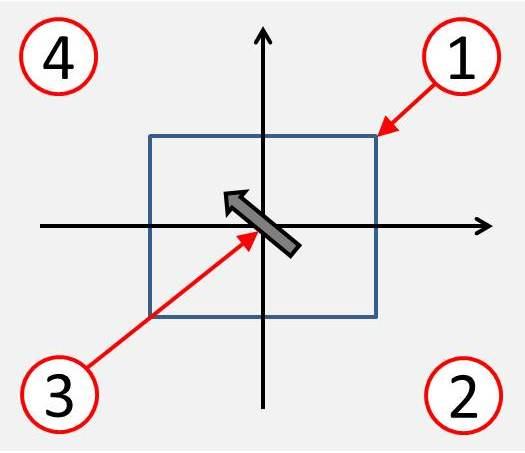
Fig. 1 Cross Caster – Cross Camber
1 – Specification Target Area Cross Caster/Camber
2 – Quadrant 2 (Left Pull Region)
3 – Increase/Decrease Cross Caster/Camber Setting
4 – Quadrant 4 (Right Pull Region)
It is important to make sure the direction of change in cross camber and/or cross caster addresses and counteracts the customer complaint. An example would be, if a vehicle shows a left lead/pull condition and the alignment data (cross-camber, cross-caster) falls into the second quadrant (2), the repair must move the alignment setting (3) toward the fourth quadrant (4) (Fig. 1). This means that the cross camber values should decrease and/or the cross caster values should increase to counteract the left lead/pull condition. On the other hand, if a vehicle shows a right lead/pull condition and the alignment data (cross-camber, cross-caster) falls into the forth quadrant (4), the repair must move the alignment setting (3) toward the second quadrant (2) (Fig. 1). This means that the cross camber values should increase and/or the cross caster values should decrease to counteract the right lead/pull condition.
If the vehicle’s initial cross camber and cross caster alignment values fall in the first or third quadrant, the repair should focus specifically on cross camber or cross caster adjustment to bring the final alignment values toward the second or fourth quadrant depending on the customer complaint. Avoid adjustments that increase cross camber and cross caster at the same time or decrease cross camber and cross caster at the same time, since the effect of the cross camber change cancels the effect of the cross caster change, making the final result ineffective to counteract the lead/pull condition.
NOTE: Tire characteristics may alter the alignment targets so the center of the acceptable target area range may not represent the best adjustment for a specific vehicle. The goal is to set the alignment so the vehicle does not pull when driving on a normal road crown while maintaining each of the alignment measurement values. The readings may go to the outer edge of the specification target area (1) (Fig. 1).
LEAD/PULL CORRECTIVE ACTION STEP SEQUENCE:
NOTE: Ensure the Vehicle Checks for tire inflation, tire wear, suspension components, and tire cross switching have been performed first before beginning the Lead/Pull Corrective Action Step Sequence.
Follow the corrective action step sequence to properly correct a lead/pull condition. Always road test the vehicle on the same road used for the initial road test to verify that the vehicle drives straight ahead without a lead/pull to the left or right. Verify that the steering wheel is centered while driving on a flat road or off-center due to road crown, which will be a normal condition. It is best to verify the centering of the steering wheel on a flat road (no road crown).
- Road test the vehicle on a flat road to verify the customer’s concern. Does the vehicle lead or pull right or left?
- Yes >>> Vehicle leads or pulls right or left. Continue with Step #2.
- No >>> Vehicle does NOT lead or pull right or left. Return the vehicle to thecustomer.
- Measure the wheel alignment.
- Is the wheel alignment within specifications?
- YES >>> Wheel alignment is within specifications. Proceed to Step #5.
- NO >>> Align the vehicle, then continue with Step #4.
- Road test the vehicle on a flat road. Does the vehicle lead or pull right or left?
- Yes >>> Vehicle leads or pulls right or left. Continue with Step #5.
- No >>> Vehicle does NOT lead or pull right or left. Return the vehicle to thecustomer.
NOTE: If the final adjustment values are offset when compared to the initial values in order to correct the lead or pull customer complaint, ensure that the cross camber and cross caster is within specifications.
- Which way does the vehicle lead or pull, right or left?
- Vehicle leads or pulls to left. Decrease cross camber and/or increase cross caster within specification.
- Vehicle leads or pulls to right. Increase cross camber and/or decrease cross caster within specification.
- Road test the vehicle on a flat road. Does the vehicle lead or pull right or left.
- Yes >>> Vehicle leads or pulls right or left. Call the STAR center for assistance.
- No >>> Vehicle does NOT lead or pull right or left. Return the vehicle to thecustomer.
FAILURE CODE:
Information Only
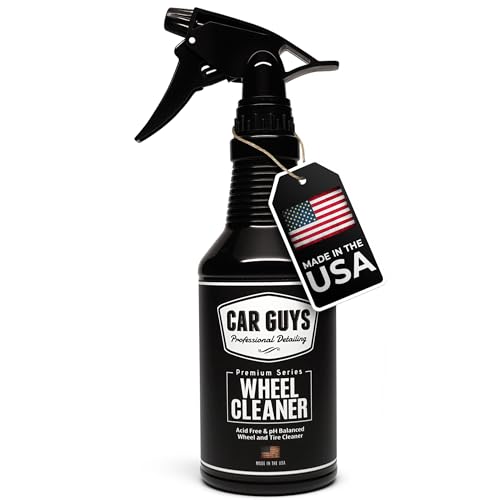
- CAR GUYS WHEEL CLEANER is a versatile brake dust cleaner that is safe on wheels, tires, and more! It's quick & easy to use, and like all our products, it’s backed with our 100% Satisfaction Guarantee!
- SAFE ON RIMS AND TIRES! – Our advanced pH Neutral formula, safely removes the toughest dirt and road grime on Wheel and Tires. Works to clean your calipers, rotors, exhaust tips, old tire dressings, and is a great whitewall tire cleaner too! Safe on alloy, chrome, aluminum, and much more!
- QUICK & EASY TO USE! – Nobody likes wasting time and money. Our highly concentrated cleaning gel is ready to spray right out of the bottle, but can also be diluted with water to extend the longevity of the liquid. Clings to wheels so each spray has minimal runoff, for maximum cleaning power!
- WHY CHOOSE CAR GUYS? – We Care About Quality! Our products are made with the latest advancements in science, using the best equipment available. This helps us make consistently high quality products that always work great! Every formula we make is mixed and bottled, in the USA, by hard working Americans!
- REAL CUSTOMER SUPPORT! – The CAR GUYS team actually cares about customer satisfaction! If you ever have any concerns, let us know, and a person from our team will do everything in our power to make it right.
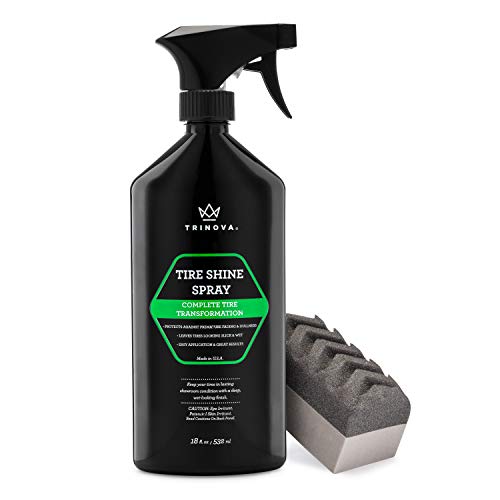
- GIVE YOUR TIRES A SLICK FINISH – TriNova’s Tire Shine Spray is the easiest way to give your tires the dark and shiny look you want. Say goodbye to those faded and dusty tires
- ADVANCED COATING & PROTECTION – Not only will this spray give your tires the shine you’re looking for, it’ll also protect them from other deteriorating signs of aging. With just a single coating of this Tire Shine, your rubber tires will be guarded
- REPELS DIRT & GRIME – TriNova’s Tire Shine Spray also offers additional protection against outside elements that can ruin your car’s appearance and also damage your tires along the way. With this spray, you won’t have to worry about water spots or salt stains
- GET THE SHINE YOU WANT – High shine, medium shine or low shine, with this spray you can achieve whichever level of shine you want. Doing so is easy: the longer you leave the spray on your tires, the more shine you’ll see when you wipe it off.
- ACHIEVE A SHINE THAT LASTS – Unlike other shine sprays, you won’t have to apply TriNova’s Tire Shine Spray multiple times a week. With this product, your tires will get a gloss that lasts longer than that you’d get from any other product on the market.
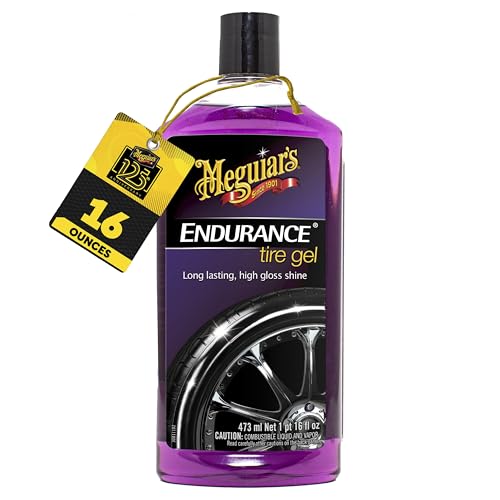
- PROTECTS AND SHINES TIRES: One 16 oz bottle of Meguiar's Endurance Tire Gel and tire dressing with advanced macropolymers and copolymers that endure through washing and rain for a high-gloss car tire shine that lasts for weeks
- RICH GEL FORMULA: Gel eliminates runs, drips and overspray for an even, consistent shine
- UV PROTECTANT: Meguiar's car tire shine protects tires against UV damage and browning to keep them looking like new
- TO USE: Apply a medium amount of tire shine to clean, cool tires using a soft cloth or foam applicator, then wipe off excess
- HIGH OR LOW SHINE: Apply a second coat of tire dressing for higher shine, or wipe off immediately for less shine

This product presentation was made with AAWP plugin.