
October 13, 2022 NHTSA CAMPAIGN NUMBER: 22V768000
Unsecured Fuse inside High Voltage Battery
Excessive heat may cause the fuse to fail and result in a loss of drive power, increasing the risk of a crash.
NHTSA Campaign Number: 22V768
Manufacturer Chrysler (FCA US, LLC)
Components ELECTRICAL SYSTEM
Potential Number of Units Affected 13,722
Summary
Chrysler (FCA US, LLC) is recalling certain 2022-2023 Jeep Wrangler Plug-In Hybrid Electric (PHEV) vehicles. The high voltage (HV) battery pack assembly was built with incorrect fasteners to secure the 200-amp fuse, which can generate excessive heat.
Remedy
Dealers will inspect and replace the HV battery fuse, as necessary. Dealers will also inspect the battery assembly for damage and replace it, if necessary. Repairs will be performed free of charge. Owner notification letters were mailed December 8, 2022. Owners may contact Chrysler customer service at 1-800-853-1403. Chrysler’s number for this recall is Z71.
Notes
Owners may also contact the National Highway Traffic Safety Administration Vehicle Safety Hotline at 1-888-327-4236 (TTY 1-800-424-9153), or go to www.nhtsa.gov.
Check if your Vehicle has a Recall
New Safety Recall Advanced Communication – Z71
FCA US LLC (FCA US) has announced a safety recall on certain 2021 Model Year (JL) Jeep® Wrangler 4XE PHEV vehicles equipped with a 2.0L engine (sales code ECX).
REASON FOR THIS SAFETY RECALL
Some of the above vehicles may have been built with an incorrect fastener to retain the 200-amp fuse. An incorrect fastener can cause high resistance in the 200-amp fuse interface, which will generate heat. Excessive heat in the fuse interface may cause the fuse to fail resulting in a loss of motive power, which can cause a vehicle crash without prior warning.
SERVICE ACTION
FCA US will conduct a voluntary safety recall to inspect the High Voltage Battery (HVB) fuse for the correct fasteners. If an incorrect fastener is found, FCA US will replace the fuse assembly. If charring or discoloration is present on the bus bars, FCA US will replace the HVB pack assembly. The remedy for this condition is not currently available. Dealers will be notified of the launch of this safety recall by way of established communication methods. This recall is estimated to launch in 4th Quarter of 2022.
December 2022
Dealer Service Instructions for:
Safety Recall Z71 / NHTSA 22V-768 High Voltage Battery Fuse
Remedy Available
2022-2023 (JL) Jeep Wrangler 4XE PHEV
NOTE: This campaign applies only to the above Plug-In Hybrid Electric Vehicles (PHEV) equipped with a 2.0L engine (sales code ECX).
NOTE: Some vehicles above may have been identified as not involved in this recall and therefore have been excluded from this recall.
IMPORTANT: Some of the involved vehicles may be in dealer new vehicle inventory. Federal law requires you to complete this recall service on these vehicles before retail delivery. Dealers should also consider this requirement toapply to used vehicle inventory and should perform this recall on vehicles in for service. Involved vehicles can be determined by using the VIP inquiry process.
Subject
The high voltage battery on about 13,720 of the above vehicles may have been built with an incorrect fastener to retain the 200 amp fuse. An incorrect fastener can cause high resistance in the 200 amp fuse interface, which will generate heat. Customer may notice a Malfunction Indicator Lamp (MIL), a change in drivability, and/or noise at the HV battery pack assembly. Excessive heat in the fuse interface may cause the fuse to fail resulting in a loss of motive power, which can cause a vehicle crash without prior warning.
Repair
Inspect fuse tray 200A fuse for proper fasteners and signs of carbon marks on bus bars. If incorrect fasteners are found with no carbon marks on bus bars, replace the 200A fuse and fasteners. If carbon marks are found, photograph the fasteners and bus bar contacts then replace HV battery as directed by the service procedure.
Alternate Transportation
Dealers should attempt to minimize customer inconvenience by placing the owner in a loaner vehicle if inspection determines that replacement is required, and the vehicle must be held overnight.
Parts Information
NOTE: All vehicles will require the Authorized Modifications Label
| Part Number | Qty. | Description |
| 04275086AE | 1 | Label – Authorized Modifications |
NOTE: If Inspection Procedure confirms that a new fuse and fasteners are required, order Fuse Campaign Kit below:
| Part Number | Description |
| CSANZ711AA | Fuse Campaign Kit |
| Each package contains the following components: | |
| Quantity | Description |
| 1 | 200 Amp Fuse |
| 2 | Fasteners |
NOTE: If Inspection Procedure confirms that a new battery is required, open a STAR case. Photographs of battery contacts damage must be attached to the STAR case.
| Part Number | Qty. | Description |
| 68488244AA | 1 | 400V Battery |
| 68163849AB | 1 | Coolant |
| 06512293AA | 3 | Bolt, Rear Seat |
Parts Return
Return instructions for the old battery are included in the container with the new battery. There is a $core charge for this battery.
NOTE: If the battery return instructions are missing, a battery return I-sheet can be downloaded from DealerCONNECT on the “Parts Tab” under the heading “Returns”.
Special Tools
The following special tools are required to perform this service procedure:
| ➢ 126-1587 | Meter, Multi – Originally Shipped In Kit Number(s) 10389. |
| ➢ NPN | High Voltage Personal Protection Equipment: Hard Hat, Safety Glasses, Protective Gloves, Safety Barriers, etc. (Consult Service Library High Voltage Safety Procedures) |
If service procedure determines that the battery must be replaced. The following special tools are required to perform battery replacement:
| ➢ NPN | wiTECH MicroPod II |
| ➢ NPN | Laptop Computer |
| ➢ NPN | wiTECH Software |
| ➢ 2035100082 | Covers, HEV Battery Terminal |
| ➢ 2035203080 | Eyebolt, 10mm |
| ➢ 2035200080 | Lift Straps, HV Battery |
Service Procedure
Only individuals with high voltage training and repair qualifications should be allowed to handle, troubleshoot or repair High Voltage or Hybrid components or systems.
Always wear safety glasses.
Review High Voltage Safety Procedures in Service Library section 08, Standard Procedures.
WARNING: Before performing any diagnostic or service procedure, you must thoroughly read and follow all applicable high voltage safety procedures. You must perform the high voltage power down procedures.
Loss of Isolation (LOI) must be performed before high voltage power up in cases where service has been performed on a high-voltage component or when diagnosing a LOI condition.
Be sure to use the proper safety equipment when working on any high voltage system or component. Failure to do so may result in serious or fatal injury.
Wait a minimum of two minutes after performing the high voltage battery disconnect procedure safety procedures before attempting to access the high voltage system, failure to do so may result in serious or fatal injury.
CAUTION: Do not allow coolant to come in contact with any high voltage component electrical connections. Engine coolant will create a conductive path and cannot be effectively removed resulting in a loss of isolation and replacement of the contaminated high voltage component.
A. Power Down the High Voltage System
- Power down the high voltage system. If the HV battery will not power down or the vehicle has a welded contactor DTC active that will not clear, stop and perform the “HV Battery Servicing with Welded Contactor(s)” at the beginning of the PHEV Battery removal procedure in Service Library.
NOTE: When performing any repairs that involve contact with high voltage components or systems, the technician performing repairs on the vehicle must verify that the system remains powered down during high voltage repairs.
- This is done by removing the test points access cover.
- The high voltage power down procedure must be performed to ensure that the high voltage battery is properly powered down.
- The technician must know the whereabouts of the test points access cover throughout the repair.
- The technician must ensure that the test points access cover is not reinstalled while service is being performed.
- The technician must recheck that the test points access cover has not been reinstalled in cases where the vehicle was unattended.
- Prepare the work area and familiarize yourself with all HIGH-VOLTAGE SAFETY PROCEDURES related to personal safety and vehicle safety associated with working on a Plug-In Hybrid Electric Vehicle (PHEV). See High Voltage Safety Procedures in Service Library section 08, Standard Procedures.
- Inspect all orange high-voltage cables, and high-voltage components labeled with the high-voltage symbol for physical damage. If damage is present, extra caution must be taken to avoid contact with unprotected high-voltage. Do not insert probes, tools, objects or fluids into damaged high-voltage cables or components.
- Disconnect any charging equipment. Do not plug in the EVSE Recharge Coupler when working on the vehicle.
- Turn the ignition to Off by pressing the keyless go button (1) and move keys away from the car a minimum of 20 feet (Figure 1).
NOTE: If the READY indicator is NOT illuminated in instrument cluster, the vehicle is already shut off. DO NOT push the start/stop button as the vehicle may start.
- Wait five minutes to allow the high-voltage system to shut down without setting a fault code.
- Disconnect the IBS wire harness connector (2). Remove and isolate the battery negative cable (1) using Covers, HEV Battery Terminal 2035100082 (Figure 2).
- Remove the F09 (5 amp) fuse (3) from the Power Distribution Center (PDC) (Figure 2).
NOTE: This removes the fused B+ power supply to the Integrated Dual Charger Module (IDCM). Disabling the IDCM disables the DC/DC conversion between the HV battery and the charging output to the low voltage side of the system.
- Verify the multi-meter is operating correctly by measuring voltage from a known good power source, such as the vehicle’s 12-volt battery. If at any point during the procedure, the multi-meter settings are changed, or the probes are repositioned in the meter, verification with a known good power source must be repeated.
- Using a multi-meter, check for voltage at the PDC fused B+ terminal to verify the low voltage system is powered down. The 12-volt electrical system is now powered down. There should be no voltage present with the IDCM disabled and the 12-volt battery disconnected.
- The high voltage service test points access cover (1) is located on the battery pack, under driver side rear seat cushion (Figure 3).
- Remove the M6 Torx screws (2) from the high voltage service test points access cover (1) (Figure 3).
- Carefully remove the test points access cover (1) and set in a protected location such that the cover plate alignment and HVIL pins are not damaged (Figure 3).
NOTE: Lift the cover straight up to avoid bending or damaging the pin on the cover that is used to engage the HVIL switch (Figure 4).
NOTE: Removal of the test points access cover will affect the following:
- Disables the High Voltage Battery System by disengaging the internal High Voltage Interlock (HVIL) pin from the switch.
- Provides access to the high voltage positive and high voltage negative test points.
NOTE: These circuits are a sense circuit connected through large resistors inside the high voltage battery to the high voltage bus cables after the contactors. These circuits are safe even when high voltage is present on the circuits due to the large resistors reducing these circuits to milliamperes.
- Provides access to the fuse cover screw.
- Allows access to a service lockout loop.
NOTE: Always observe these precautions prior to taking a high-voltage measurement:
- Be sure to utilize the proper Personal Protection Equipment (PPE) when working on any high voltage system.
- Rated and non-expired rubber insulating gloves with leather protectors.
- Have known good test leads.
- Verify the multi-meter leads are rated “CAT III 1,000V”. This should be printed on the multi-meter leads.
- Install the multi-meter leads in the BLACK and RED sockets on the right side of the Fluke 1587 (VΩ (RED) and COM (BLACK)).
- Switch the FLUKE 1587 to the DC Volts selection and press the RANGE button until the 500V range is selected – just one digit (a zero) is displayed.
- Test the multi-meter operation by measuring the voltage across the 12volt Battery.
- Use of an insulation tester such as the Fluke Meter, Multi 126-1587 is recommended for PHEV circuit testing. Perform the multi-meter functionality tests per the manufacturer’s directions. Verify the multi-meter is operating correctly by measuring voltage from a known good power source, such as the vehicle’s 12-volt battery. If at any point during the procedure, the multi-meter settings are changed, or the probes are repositioned in the meter, verification with a known good power source must be repeated (Figure 5).
- Using the Fluke multi-meter, measure the voltage at the high voltage positive and high voltage negative test points (Figure 6):
- Measure for voltage between the positive and negative high voltage test points.
- Measure for voltage between positive test point and chassis ground.
- Measure for voltage between negative test point and chassis ground.
- The voltage reading should be 0 volts. (Some residual voltage may be present, up to 2.0 volts may be normal) (Figure 6).
- If the voltage measured is below 2 volts, it is safe to work on the high-voltage components with the exception of the high-voltage battery internal components.
- If the voltage is greater than 60 volts, an internal condition exists within the high voltage battery such as stuck contactors, that are preventing it from being powered down. This should be accompanied by contactor stuck DTCs. Do not attempt to carry out testing on any of the vehicle’s high-voltage components or wiring. The HV Battery Pack requires replacement. Reference the HV BATTERY SERVICING WITH WELDED CONTACTOR(S) procedure at the top of the HV PHEV BATTERY REMOVAL AND INSTALLATION procedure for safely removing a high voltage battery that will not power down (Refer to 08 – Electrical/Battery System/BATTERY/Removal and Installation).
- If the voltage is between 2.0 volts and 60 volts, the HV system is safe to work on, however there is a problem that should be diagnosed. Disconnect each of the following HV modules one at a time and check the voltage at the test points. If the voltage drops to 2.0 volts or less, the faulted module has been found. Reconnect each module before continuing to the next.
-
- Integrated Dual Charger Module (IDCM)
- Electronic A/C Compressor (EAC)
- Battery Coolant Heater
- HV Coolant Heater
- Power Inverter Module (PIM)
B. High Voltage Fuse Inspection/Replacement
- Do the 200A fuse fasteners have a flange around the screw head or not as shown in (Figure 9)?
- Correct Screws – Flange Head: No further action required. Vehicle may be reassembled. Proceed to Step 10.
- Incorrect Screws – No Flange: Continue with Step 4.
- Inspect the 200A fuse and bus bar contacts for any signs of carbon marking as shown in (Figure 10).
- Photograph the bus bar and 200A fuse contact surfaces. Photographs showing the contact surfaces of the bus bar and 200A fuse will be required for the parts ordering process (Figure 10).
- Were the bus bar contacts clean or carbon marked as shown in (Figure 10)?
- Clean, no Carbon Marks: Replace the 200A fuse and fasteners. Continue with Step 9.
- Visible Carbon Marks: Battery will require replacement Proceed to Section C.
- Order and obtain the 200A fuse kit with proper screws. The photographs taken previously will be required to place the parts order.
- Replace the 200A fuse and fasteners from the kit then tighten the screws to 5.7 N·m (50 in. lbs.) (Figure 8)
- Install the fuse cover then tighten the cover screw to 6 N·m (53 in. lbs.) (Figure 7).
- Power up the HV battery system.
NOTE: When performing any repairs that involve contact with high voltage components or systems, the technician performing repairs on the vehicle must verify that the system remains powered down during high voltage repairs.
- This must be done by removing the test points access cover.
- The high voltage power down procedure must also be performed to ensure that the vehicle is properly powered down.
- The technician must know the whereabouts of the test points access cover throughout the repair.
- The technician must ensure that no one reinstalls the test points access cover while service is being performed.
- The technician must recheck that the test points access cover has not been reinstalled in cases where the vehicle was unattended.
- Use of an insulation tester such as the Fluke Meter, Multi 126-1587 is recommended for Plug-In Hybrid Electric Vehicle (PHEV) circuit testing. Perform the multi-meter functionality tests per the manufacturer’s directions. Verify the multi-meter is operating correctly by measuring voltage from a known good power source, such as the vehicle’s 12-volt battery. If at any point during the procedure, the multi-meter settings are changed, or the probes are repositioned in the meter, verification with a known good power source must be repeated.
NOTE: Always observe these precautions prior to taking an isolation resistance measurement:
- Have known good test leads
- Set the test voltage to 500 Volts
- Always wear safety glasses
- Using the Meter, Multi 1261587 measure and record the isolation resistance between the high voltage positive test point and chassis ground (Figure 11).
- Using the Meter, Multi 1261587 measure and record the isolation resistance between the high voltage negative test point and chassis ground (Figure 12).
- Isolation resistance should be 2.3 Mohms (+/-.2). If the measured isolation resistance is outside of this range, a loss of isolation condition exists within the high voltage circuitry. Do not continue the High Voltage Power Up procedure until the condition causing the loss of isolation is corrected.
- Install the test points access cover (1) to the battery pack and tighten the eight M6 Torx screws (2) to 8.8 N·m (78 in. lbs.) (Figure 13).
- Remove the cover, connect the negative battery cable to the IBS and tighten the fastener (1) to 10N·m (7 ft. lbs.) (Figure 14).
- Install the F09 (5 amp) IDCM fuse (3) in the Power Distribution Center (PDC) (Figure 14).
- Connect the IBS harness connector (2) (Figure 14).
- Perform Section D. Install the Authorized Modifications Label.
- If fuse did not require replacement, record on label “Fuse Inspected”.
- If fuse did require replacement, record on label “Fuse Replaced”.
- For California residents, complete Section E. Proof of Correction Form.
- Return the vehicle to customer or inventory.
C. HV Battery Replacement
NOTE: Observe the following precautions when handling the HV battery pack:
- DO NOT touch the high voltage terminals.
- Always use the battery pack four lift points when moving the battery pack.
- Keep the battery pack in an upright position.
- Store in a clean and dry environment.
- Store at a temperature of 10-30°C (50-86°F) with relative humidity between 30-70%.
- Always store at a State Of Charge (SOC) of around 30%.
- Always store on an electrically nonconducting (insulated) material.
- Store with spatial gap of at least 50 cm (20 in.).
- DO NOT store the battery pack near any environmental condition involving liquid, heat, strong magnetic field, electricity or that can generate heat (for example: transformers).
NOTE: The HV battery pack weighs 167 kg (368 lb.).
NOTE: If the High Voltage (HV) battery is missing its return instructions, contact the UPS Call Center 800-567-9989.
- Loosen the cap on the high voltage cooling reservoir.
- Raise and support the vehicle.
- Remove the eight push pin fasteners from the front air dam (1) (Figure 15).
- Remove the bolts (2) (Figure 15).
- Remove the air dam (1) (Figure 16).
- Remove the support and lower the vehicle.
- Disconnect the vacuum boost hose quick coupling (1) from the air cleaner body cover (Figure 17).
- Push in and hold both sides of the gray release (1) on the quick coupling (Figure 18).
- Pull the quick coupling away from air cleaner body cover.
- Disconnect the fuel vapor purge hose quick coupling (2) from the air cleaner body cover (Figure 17).
- Do not press on the green antitampering feature (1) (Figure 19).
- Push in and hold only the side of the release (2) with the green anti-tampering feature and pull the quick coupling away from air cleaner body cover.
- Loosen the clean air hose band clamp (2) (Figure 20).
- Remove the bolt (3) (Figure 20).
- Disengaging the air cleaner body (1) from the two lower rubber grommets and from the clean air hose (Figure 20).
- Raise and support the vehicle.
- Position a drain pan under the coolant hoses (Figure 21).
- Remove the coolant hoses from the coolant line and drain the power electronics cooling system (Figure 21).
- Once the system is completely drained, reinstall the coolant hose to the coolant line (Figure 21).
- Remove the fasteners (1) and the skid plate (2) from the vehicle (Figure 22).
- Disconnect the HV wire harness connectors (1) and (2) from the HV battery (Figure 23).
- Cap the HV cables using Covers, HEV Battery Terminal 2035100082.
NOTE: A Plug-in Hybrid Electric Vehicle (PHEV) HV Battery Cover/Plug Kit is also available from Mopar® Parts.
- Remove the support and lower the vehicle.
- Using a trim stick, release and remove the B-pillar trim cover (1) (Figure 24).
- Disconnect the wire harness connector (2) and release the door tether from the support bracket (1) (Figure 25).
- Remove the bolt (2) securing the door check (1) (Figure 26).
- Remove the nuts (3) and lift the door up off hinges (1) and remove (Figure 27).
- Raise the rear seat cushion.
- Remove the fasteners (1) from the side high voltage battery trim panels (2) (Figure 28).
- Using a trim stick or equivalent, remove the high voltage trim panel upward to release the retainers and remove the trim panel. Repeat for the passenger side.
- Lower the rear seat cushion.
- Using a trim stick or equivalent, release the retainers from the front high voltage battery closeout and remove from vehicle (Figure 29).
- Remove the rear seat to load floor gap hider (Figure 30).
- Disconnect the wire harness connectors, if equipped (4) (Figure 31).
- Remove the nut for the center seat belt anchor (6). Remove the seat belts from the floor stud (Figure 31).
- Disconnect the wire harness connectors (3), if equipped (Figure 32).
- Remove the bolts (1) at the front of the rear seat (Figure 32).
- Remove silencer pad (Figure 33).
- Remove the seat from the vehicle.
- Remove the fastener (1) and the chassis ground cable from the HV battery (2) (Figure 34).
- Disconnect the HV wire harness connectors (1) (Figure 35).
NOTE: Use an absorbent pad to collect any coolant that may leak from the battery into the interior of the vehicle.
NOTE: The HV battery pack weighs 167 kg (368 lb.).
- Remove the bolts (1) securing the HV battery to the vehicle (Figure 37).
- Install two Eyebolt, 10mm 2035203080 with the nuts to the front support mounting holes (1) (Figure 38).
- Thread the other two Eyebolt, 10mm 2035203080 (1) into the threaded holes next to the HV battery pack mounting bolt holes (2) on the rear side of the HV battery pack (Figure 39).
- Connect the Lift Straps, HV Battery 2035200080 to the eyebolts and the lifting device. Adjust the straps so that the battery will be level during lifting as shown in the picture (Figure 40).
- Remove the HV battery pack from the vehicle.
NOTE: When the HV battery pack is being replaced:
- Refer to the information supplied with the NEW battery.
- All coolant must be removed from the battery. Use a shop air supply hose connected to the battery coolant inlet port. Adjust the air pressure regulator to not exceed 100 kPa (15 psi) and force the coolant from the battery coolant outlet port.
- All coolant ports and electrical connections must be capped.
- Place the HV battery pack in the shipping container or in a suitable storage location properly supported to prevent damage to the underside of the battery.
- Attach the Eyebolt, 10mm 2035203080 to the new HV battery pack in the same locations that were used for the removal. Connect the Lift Straps, HV Battery 2035200080 on the front and rear eyelets.
- Secure the HV battery pack to the lifting device.
- Install the HV battery pack in the vehicle making sure that the mounting holes align with the bolt holes in the body.
- Remove the lifting strap and eyebolts.
- Install the HV battery pack bolts (1) and tighten to (Figure 37):
- High Voltage Battery to Chassis M10 Bolts tighten to 45N·m (33 ft. lbs.).
- High Voltage Battery to Chassis M8 Bolts tighten to 21N·m (15 ft. lbs.).
- Install the chassis ground cable to the HV battery ground stud (1) and tighten to 9N·m (80 in. lbs.) (Figure 36).
- Connect the three HV wire harness connectors (1) (Figure 34).
- Install the silencer pad (Figure 33).
- Install the rear seat to the vehicle.
- Install the bolts at the front of the rear seat and tighten to 70N·m (52 ft. lbs.).
- Connect the wire harness connectors, if equipped (Figures 31 and 32).
- Install the seat belts from the floor stud.
- Install the nut for the center seat belt anchor and tighten to 70N·m (52 ft. lbs.).
- Raise the rear seat cushion.
- Install the rear seat to load floor gap hider.
- Align and install the retainers from the front high voltage battery closeout to the vehicle (Figure 29).
- Install the high voltage trim panel and press downward to seat the retainers (Figure 28).
- Install the fasteners to the side high voltage battery trim panels and tighten securely.
- Lower the rear seat cushion.
- Set the door into place on the hinges and install the door hinge pivot nuts. Tighten the nuts to 6N·m (53 in. lbs.) (Figure 27).
- Install the door check strap bolt securing the door check and tighten to 9N·m (80 in. lbs.) (Figure 26).
- Connect the wire harness connector and secure the door tether to the support bracket (Figure 25).
- Align and install the B-pillar trim cover (Figure 24).
- Raise and support the vehicle.
NOTE: When connecting the High Voltage connection verify that the connectors are clean and seated properly.
- Remove the battery port covers and transfer them to the old battery. Connect the HV wire harness connectors (1) and (2) to the HV battery and tighten to 9N·m (80 in. lbs.) (Figure 23).
- Install the battery skid plate (2) and tighten the fasteners (1) to 25N·m (18 ft. lbs.)
- Remove the support and lower vehicle.
WARNING: ANTIFREEZE COOLANT IS HARMFUL IF SWALLOWED OR INHALED. IF SWALLOWED, DRINK TWO GLASSES OF WATER AND INDUCE VOMITING. IF INHALED, MOVE TO FRESH AIR AREA. SEEK MEDICAL ATTENTION IMMEDIATELY. DO NOT STORE IN OPEN OR UNMARKED CONTAINERS. WASH SKIN AND CLOTHING THOROUGHLY AFTER COMING IN CONTACT WITH ETHYLENE GLYCOL. KEEP OUT OF REACH OF CHILDREN. DISPOSE OF GLYCOL BASED COOLANT PROPERLY. CONTACT YOUR DEALER OR GOVERNMENT AGENCY FOR LOCATION OF COLLECTION CENTER IN YOUR AREA. DO NOT OPEN A COOLING SYSTEM WHEN THE ENGINE IS AT OPERATING TEMPERATURE OR HOT UNDER PRESSURE; PERSONAL INJURY CAN RESULT. AVOID RADIATOR COOLING FAN AND OTHER MOVING COMPONENTS WHEN ENGINE COMPARTMENT RELATED SERVICE IS PERFORMED; PERSONAL INJURY CAN RESULT.
WARNING: WEAR APPROPRIATE EYE AND HAND PROTECTION WHEN PERFORMING THIS PROCEDURE.
- Fill the battery cooling system.
NOTE: Fill the High Voltage (HV) battery cooling system with the recommended MOPAR Antifreeze Coolant (Refer to 04 – Vehicle Quick Reference/Capacities and Recommended Fluids/Specifications in Service Library).
- Power up the HV battery system.
NOTE: When performing any repairs that involve contact with high voltage components or systems, the technician performing repairs on the vehicle must verify that the system remains powered down during high voltage repairs.
- This must be done by removing the test points access cover.
- The high voltage power down procedure must also be performed to ensure that the vehicle is properly powered down.
- The technician must know the whereabouts of the test points access cover throughout the repair.
- The technician must ensure that no one reinstalls the test points access cover while service is being performed.
- The technician must recheck that the test points access cover has not been reinstalled in cases where the vehicle was unattended.
- Use of an insulation tester such as the Fluke Meter, Multi 126-1587 is recommended for Plug-In Hybrid Electric Vehicle (PHEV) circuit testing. Perform the multi-meter functionality tests per the manufacturer’s directions. Verify the multi-meter is operating correctly by measuring voltage from a known good power source, such as the vehicle’s 12-volt battery. If at any point during the procedure, the multi-meter settings are changed, or the probes are repositioned in the meter, verification with a known good power source must be repeated.
- Remove the M6 Torx screws from the high voltage service test points access cover (Figure 41).
- Carefully remove the test points access cover and set in a protected location such that the cover plate alignment and HVIL pins are not damaged (Figure 41).
NOTE: Lift the cover straight up to avoid bending or damaging the pin on the cover that is used to engage the HVIL switch.
NOTE: Always observe these precautions prior to taking an isolation resistance measurement:
- Have known good test leads
- Set the test voltage to 500 Volts
- Always wear safety glasses
- Using the Meter, Multi 126-1587 measure and record the isolation resistance between the high voltage positive test point and chassis ground (Figure 42).
- Using the Meter, Multi 126-1587 measure and record the isolation resistance between the high voltage negative test point and chassis ground (Figure 43).
- Isolation resistance should be 2.3 Mohms (+/-.2). If the measured isolation resistance is outside of this range, a loss of isolation condition exists within the high voltage circuitry. Do not continue the High Voltage Power Up procedure until the condition causing the loss of isolation is corrected.
- If required, remove the lockout-tagout padlock from the service lockout loop (1) (Figure 44).
- Install the test points access cover (1) to the battery pack and securely tighten the eight M6 Torx screws (2), identified with blue circles (Figure 44).
- Remove the cover, connect the negative battery cable to the IBS and tighten the fastener (1) to 10N·m (7 ft. lbs.) (Figure 45).
- Install the F09 (5 amp) IDCM fuse (3) in the Power Distribution Center (PDC) (Figure 45).
- Connect the IBS harness connector (2) (Figure 45).
- Using the scan tool, delete any DTCs that may have set due to the IDCM fuse being removed. Turn the key OFF and wait 2 minutes,
- Use the scan tool and flash program the BPCM with the latest software.
- Use the scan tool and perform the “Enable Contactor for Service” procedure in BPCM.
NOTE: If these procedures are not performed, the vehicle will not start. The high voltage battery pack is shipped with the contactors locked in the open position for safety concerns. Until these routines are performed, the battery pack contactors will not close resulting in a no start condition.
- Close the hood, press the START button and verify that the Hybrid Status Indicator is green and no warnings are displayed.
FILL AND BLEED USING THE SCAN TOOL (PREFERRED)
a) Fill the HV battery pressurized coolant bottle to the max level.
b) Cycle the ignition to the on position.
c) With the scan tool, run the “Coolant Fill Procedure” routine in the Hybrid Control Processor (HCP). This should run all of the coolant pumps in all cooling systems.
d) Continue adding coolant to the HV battery pressurized coolant bottle maintaining the coolant at the max level.
e) When no more coolant is needed the system is filled and bled. The routine may time out before the system is full and take multiple cycles to bleed all of the air from the system.
f) Stop the scan tool actuation. Fill the bottle slightly above the fill line in case of any air trapped in the system.
FILL AND BLEED WITHOUT THE SCAN TOOL
a) Fill the HV battery pressurized coolant bottle to the max level.
b) Cycle the key to the on position to power the battery coolant pump in order to fill and bleed the HV cooling system.
c) Cycle the key to the off position after the pump times out and stops running.
d) Fill the HV battery pressurized coolant bottle to the max level.
e) Repeat the fill procedure until the proper coolant level is achieved. Fill the bottle slightly above the fill line in case of any air trapped in the system.
- Perform Section D. Install the Authorized Modifications Label.
- If battery require replacement, record on label “Battery Replaced”.
- For California residents, complete Section E. Proof of Correction Form.
- Return the vehicle to the customer or inventory.
Chronology :
- On April 25, 2022, FCA US LLC (“FCA US”) Technical Safety and Regulatory Compliance (“TSRC”) organization opened an investigation after receiving a report of a damaged fuse in the HV battery pack assembly on a 2022 MY Jeep Wrangler PHEV.
- On April 26, 2022, FCA US received a second report of a damaged fuse in the HV battery.
- On April 29, 2022, FCA US received a third report of a damaged fuse in the HV battery.
- On May 2, 2022, FCA US determined an incorrect fastener was used to secure the 200 amp fuse in the HV battery.
- On June 24, 2022, FCA US received a report of a damaged fuse in the HV battery and arranged to have the battery returned to the supplier.
- On September 9, 2022, FCA US received confirmation of the wrong fastener used to secure the 200 amp fuse in the HV battery.
- As of September 29, 2022, FCA US is aware of three customer records, three warranty claims, and six field reports potentially related to this issue for all markets with dates of receipt ranging from March 26, 2022 to June 24, 2022.
- As of September 29, 2022, FCA US is not aware of any accidents or injuries potentially related to this issue for all markets.
- On October 6, 2022, FCA US determined, through the Vehicle Regulations Committee, to conduct a voluntary safety recall of the affected vehicles.
2 Affected Products
Vehicle
| MAKE | MODEL | YEAR |
| JEEP | WRANGLER | 2022-2023 |
11 Associated Documents
Recall Acknowledgement
RCAK-22V768-2540.pdf 645.302KB
Manufacturer Notices(to Dealers,etc)New Safety Recall Advanced Communication – Z71
Defect Notice 573 Report
RCLRPT-22V768-9286.PDF 214.348KB
Manufacturer Notices(to Dealers,etc) – New Safety Recall Advanced Communication – Z71
Manufacturer Notices(to Dealers,etc) – NSRAC Final
Remedy Instructions and TSB
RCRIT-22V768-7151.pdf 1904.617KB
ISSUED Owner Notification Letter(Part 577)
RCONL-22V768-2822.pdf 176.38KB
Recall Quarterly Report #1, 2022-4
RCLQRT-22V768-8895.PDF 211.154KB
ISSUED Renotification Notice
Recall Quarterly Report #2, 2023-1
RCLQRT-22V768-6070.PDF 211.256KB
Recall Quarterly Report #3, 2023-2
RCLQRT-22V768-3524.PDF 211.35KB
Latest Recalls Documents

- Flex Level 1 EV Charger - The EVDANCE Level 1 electric car charger is compatible with J1772 electric vehicles and plug-in hybrid vehicles (North American Standard). *Tesla requires a SAE J1772 adapter.
- Convenient to Use - This charger has both NEMA 6-20 plug for 16A 240V charging (3.68kW, 10-12 mi/h) and a NEMA 6-20 to 5-15 plug adapter for 12A 120V charging (1.44kW, 2-5 mi/h). The included bag makes it easier to carry on the go. It also has a 25ft cable length, you can use it flexibly from anywhere in the garage or driveway.
- Check Your Outlet Type -This charger works with standard 120V NEMA 5-15/5-20 outlets (2-5 mph charging speed) and 240V NEMA 6-20 outlets (10-12 mph) . It's not compatible with NEMA 6-15/10-30/14-30/14-50/6-50 outlets – you'll need a NEMA 14-50/14-30/10-30/6-50 to 6-20 adapter (sold separately) to connect.
- Compatible EV Models -This EV charger works with most major electric vehicles, including Ford, Chevrolet, Hyundai, Audi, Nissan Ariya, Rivian R1S, Kia, and others. However, it's not compatible with Mini Cooper Electric Hardtop,Toyota Prus Prime/Z4X/RAV4Prime, Porsche Taycan Base/4S/Turbo/Turbo S or Tesla models (Tesla requires a J1772 to Tesla Adapter, sold separately). For a full list of compatible models, check out the Full Compatibility List on our product page.
- Indication Displays - LED display that can tell you the status as well as indicate errors while charging your electric vehicle.

- WORKS WITH EVERY NON-TESLA EV: Standard J1772 connector plugs straight into Ford, Chevrolet, Hyundai, Kia, Nissan, BMW, Volkswagen, Audi, Rivian, Lucid and every other EV or plug-in hybrid sold with a J1772 port - no adapter needed. Tesla drivers can charge too, using the J1772 adapter that comes with the car. The extra-long 25 ft cable easily reaches across a garage or driveway.
- HARDWIRED - PROFESSIONAL INSTALL: This Level 2 charger is hardwired (not plug-in), so a licensed electrician installs it per National Electrical Code. It delivers up to 48A on a dedicated 60A, 240V circuit - enough to charge most EVs fully overnight. Want more speed? You can set DIP switches 4 and 5 to unlock 50A on a dedicated 70A circuit. Before ordering, check your car's port type and that your electrical panel can support the circuit.
- CONTROL FROM YOUR PHONE: A stronger built-in antenna keeps the charger online even in a garage or basement. Use the free app to start and stop charging, set the charging speed (6-48A), get reminders, and track how much energy and money each charge uses. Requires a 2.4 GHz home WiFi network.
- SAFETY-CERTIFIED & WEATHERPROOF: Independently tested and certified (UL, ETL, FCC, Energy Star). A fully sealed IP66 / NEMA 4 housing stands up to rain, snow, heat and dust indoors or out, and internal steel shielding protects the electronics for years of reliable use.
- GLOW-IN-THE-DARK HOLSTER: The included high-visibility holster glows in the dark so you can find and dock the plug easily at night. Holds the connector securely when not in use.
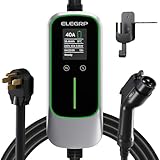
- Fast & Adjustable Charging: Up to 9.6 kW (37 mph), 7x faster than Level 1, with 5 current levels (16/20/24/32/40A) to match home capacity, plus 1–12H timing delay for off-peak charging, reducing costs and easing range anxiety
- Plug & Extended Reach: NEMA 14-50 plug fits 240V outlets for true plug-and-play use, while the 25FT cable offers flexible reach across garages and driveways, eliminating the need to reposition vehicles for easier daily charging
- ETL Certified & ELEGRP PBE Protection: Fully ETL certified, ELEGRP’s exclusive PBE technology combines full-link overheat protection with a triple-layer safety system, ensuring safer, more efficient charging. Includes a 2-year warranty
- All-Weather Indoor & Outdoor Use: IP67-rated for durability in rain, snow, and extreme temps (-21°F to 121°F), with a portable design that supports home, travel, and outdoor charging, delivering reliable performance anywhere
- Universal Compatibility: Works seamlessly with Mercedes, Chevy, Ford, Mustang Mach-E, Cadillac, Hyundai Ioniq, Kia EV6/EV9, Nissan Leaf, Chevy Bolt, Chrysler Pacifica Hybrid, and all PHEV/BEV. Tesla compatible with NACS adapter (sold separately)

- WORKS WITH EVERY NON-TESLA EV: Standard J1772 connector plugs straight into Ford, Chevrolet, Hyundai, Kia, Nissan, BMW, Volkswagen, Audi, Rivian, Lucid and every other EV or plug-in hybrid sold with a J1772 port - no adapter needed. Tesla drivers can charge too, using the J1772 adapter that comes with the car.
- PLUG IN, NO HARDWIRING: Level 2 charger delivers up to 40A to fully charge most EVs overnight. Plugs into a 240V, 4-prong NEMA 14-50 outlet (the RV/range type - NOT a dryer outlet) on a dedicated 50A circuit. The extra-long 25 ft cable easily reaches across a garage or driveway. Before ordering, check your car's port type and that you have the right outlet.
- CONTROL & SAVE FROM YOUR PHONE: A stronger built-in antenna keeps the charger online even in a garage or basement. Use the free app to start/stop charging, set speed (6-40A), get reminders, and track energy use and cost. Schedule off-peak overnight charging to cut your electric bill. Requires 2.4 GHz WiFi.
- SAFETY-CERTIFIED & WEATHERPROOF: Independently tested and certified (UL, ETL, FCC, Energy Star). A fully sealed IP66 / NEMA 4 housing stands up to rain, snow, heat and dust indoors or out, and internal steel shielding protects the electronics for years of reliable use.
- GLOW-IN-THE-DARK HOLSTER: The included high-visibility holster glows in the dark so you can find and dock the plug easily at night. Holds the connector securely when not in use.

- Charge with Confidence: ChargePoint builds reliable, flexible EV charging stations for home, business, and fleets. Get 24/7 support and access to hundreds of thousands of North American charging locations
- Charge Smart: With the user-friendly ChargePoint Mobile App, you can control your electric car charger, manage reminders, connect to smart home devices, find stations, get data and charging info, and access the latest features
- Vast Network: Wherever you go, ChargePoint’s network includes 274k+ stations across North America and Europe and 565k+ roaming partner stations
- Safe & Durable: Rely on this UL-certified EV charger for safe home charging. It can be installed indoors or outdoors by an electrician and includes a cold-resistant cable
- Fast & Powerful: This EV charger charges 9× faster than a 120V outlet, delivering up to 45 mi/hr., dependent upon your vehicle. It features a J1772 connector for all non-Tesla EVs and plugs into a 240V outlet with a 14-50 receptacle, requiring a 40A or 50A circuit. For Tesla EVs, this will require an adapter
SEOCONTENT-START
Schedule your FREE repair today! URGENT SAFETY RECALL HIGH VOLTAGE BATTERY FUSE — Z71/22V-768 [MY Make Model] AA111111 Dear CUSTOMER NAME: Please bring your vehicle and this card to your scheduled appointment. We apologize for any inconvenience and do appreciate your attention to this urgent matter. Safety recall campaign Z71/22V-768 is open on your [MY Make® Model]. ATENCIÓN! La unidad descrita en esta carta tiene un llamado a revisión pendiente por realizer. Para protegerlo a usted y a su familia, es urgente que se comunique con el grupo FCA US al teléfono 1-800-853-1403 con el fin de programar una cita y se reparada su unidad sin costo para usted. 0000274/#105890/Z71-FSP Call 1-800-853-1403 Visit recalls.mopar.com to locate your closest dealer Download the Mopar Owner’s Companion App at either the App or Google Play Stores LOGO VEHICLE PICTURE
**************************************************************************************************************
© Copyright 2022, FCA US LLC, All Rights Reserved (tdb) December 2022 Dealer Service Instructions for: Safety Recall Z71 / NHTSA 22V-768 High Voltage Battery Fuse 2022-2023 (JL) Jeep Wrangler 4XE PHEV NOTE: This campaign applies only to the above Plug-In Hybrid Electric Vehicles (PHEV) equipped with a 2.0L engine (sales code ECX). NOTE: Some vehicles above may have been identified as not involved in this recall and therefore have been excluded from this recall. The high voltage battery on about 13,720 of the above vehicles may have been built with an incorrect fastener to retain the 200 amp fuse. An incorrect fastener can cause high resistance in the 200 amp fuse interface, which will generate heat. Customer may notice a Malfunction Indicator Lamp (MIL), a change in drivability, and/or noise at the HV battery pack assembly. Excessive heat in the fuse interface may cause the fuse to fail resulting in a loss of motive power, which can cause a vehicle crash without prior warning. Remedy Available IMPORTANT: Some of the involved vehicles may be in dealer new vehicle inventory. Federal law requires you to complete this recall service on these vehicles before retail delivery. Dealers should also consider this requirement to apply to used vehicle inventory and should perform this recall on vehicles in for service. Involved vehicles can be determined by using the VIP inquiry process. Subject Safety Recall Z71 – High Voltage Battery Fuse Page 2 Inspect fuse tray 200A fuse for proper fasteners and signs of carbon marks on bus bars. If incorrect fasteners are found with no carbon marks on bus bars, replace the 200A fuse and fasteners. If carbon marks are found, photograph the fasteners and bus bar contacts then replace HV battery as directed by the service procedure. Dealers should attempt to minimize customer inconvenience by placing the owner in a loaner vehicle if inspection determines that replacement is required, and the vehicle must be held overnight. Repair Alternate Transportation Safety Recall Z71 – High Voltage Battery Fuse Page 3 NOTE: All vehicles will require the Authorized Modifications Label Part Number Qty. Description 04275086AE 1 Label – Authorized Modifications NOTE: If Inspection Procedure confirms that a new fuse and fasteners are required, order Fuse Campaign Kit below: Part Number Description CSANZ711AA Fuse Campaign Kit Each package contains the following components: Quantity Description 1 200 Amp Fuse 2 Fasteners NOTE: If Inspection Procedure confirms that a new battery is required, open a STAR case. Photographs of battery contacts damage must be attached to the STAR case. Part Number Qty. Description 68488244AA 1 400V Battery 68163849AB 1 Coolant 06512293AA 3 Bolt, Rear Seat Return instructions for the old battery are included in the container with the new battery. There is a $ core charge for this battery. NOTE: If the battery return instructions are missing, a battery return I-sheet can be downloaded from DealerCONNECT on the “Parts Tab” under the heading “Returns”. Parts Information Parts Return Safety Recall Z71 – High Voltage Battery Fuse Page 4 The following special tools are required to perform this service procedure: ➢ 126-1587 Meter, Multi – Originally Shipped In Kit Number(s) 10389. ➢ NPN High Voltage Personal Protection Equipment: Hard Hat, Safety Glasses, Protective Gloves, Safety Barriers, etc. (Consult Service Library High Voltage Safety Procedures) If service procedure determines that the battery must be replaced. The following special tools are required to perform battery replacement: ➢ NPN wiTECH MicroPod II ➢ NPN Laptop Computer ➢ NPN wiTECH Software ➢ 2035100082 Covers, HEV Battery Terminal ➢ 2035203080 Eyebolt, 10mm ➢ 2035200080 Lift Straps, HV Battery Special Tools Safety Recall Z71 – High Voltage Battery Fuse Page 5 Only individuals with high voltage training and repair qualifications should be allowed to handle, troubleshoot or repair High Voltage or Hybrid components or systems. Always wear safety glasses. Review High Voltage Safety Procedures in Service Library section 08, Standard Procedures. WARNING: Before performing any diagnostic or service procedure, you must thoroughly read and follow all applicable high voltage safety procedures. You must perform the high voltage power down procedures. Loss of Isolation (LOI) must be performed before high voltage power up in cases where service has been performed on a high-voltage component or when diagnosing a LOI condition. Be sure to use the proper safety equipment when working on any high voltage system or component. Failure to do so may result in serious or fatal injury. Wait a minimum of two minutes after performing the high voltage battery disconnect procedure safety procedures before attempting to access the high voltage system, failure to do so may result in serious or fatal injury. CAUTION: Do not allow coolant to come in contact with any high voltage component electrical connections. Engine coolant will create a conductive path and cannot be effectively removed resulting in a loss of isolation and replacement of the contaminated high voltage component. Service Procedure Safety Recall Z71 – High Voltage Battery Fuse Page 6 A. Power Down the High Voltage System 1. Power down the high voltage system. If the HV battery will not power down or the vehicle has a welded contactor DTC active that will not clear, stop and perform the “HV Battery Servicing with Welded Contactor(s)” at the beginning of the PHEV Battery removal procedure in Service Library. NOTE: When performing any repairs that involve contact with high voltage components or systems, the technician performing repairs on the vehicle must verify that the system remains powered down during high voltage repairs. • This is done by removing the test points access cover. • The high voltage power down procedure must be performed to ensure that the high voltage battery is properly powered down. • The technician must know the whereabouts of the test points access cover throughout the repair. • The technician must ensure that the test points access cover is not reinstalled while service is being performed. • The technician must recheck that the test points access cover has not been reinstalled in cases where the vehicle was unattended. 2. Prepare the work area and familiarize yourself with all HIGH-VOLTAGE SAFETY PROCEDURES related to personal safety and vehicle safety associated with working on a Plug-In Hybrid Electric Vehicle (PHEV). See High Voltage Safety Procedures in Service Library section 08, Standard Procedures. Service Procedure [Continued] Safety Recall Z71 – High Voltage Battery Fuse Page 7 3. Inspect all orange high-voltage cables, and high-voltage components labeled with the high-voltage symbol for physical damage. If damage is present, extra caution must be taken to avoid contact with unprotected high-voltage. Do not insert probes, tools, objects or fluids into damaged high-voltage cables or components. 4. Disconnect any charging equipment. Do not plug in the EVSE Recharge Coupler when working on the vehicle. 5. Turn the ignition to Off by pressing the keyless go button (1) and move keys away from the car a minimum of 20 feet (Figure 1). NOTE: If the READY indicator is NOT illuminated in instrument cluster, the vehicle is already shut off. DO NOT push the start/stop button as the vehicle may start. 6. Wait five minutes to allow the high-voltage system to shut down without setting a fault code. Service Procedure [Continued] Figure 1 – Keyless Go Button Safety Recall Z71 – High Voltage Battery Fuse Page 8 7. Disconnect the IBS wire harness connector (2). Remove and isolate the battery negative cable (1) using Covers, HEV Battery Terminal 2035100082 (Figure 2). 8. Remove the F09 (5 amp) fuse (3) from the Power Distribution Center (PDC) (Figure 2). NOTE: This removes the fused B+ power supply to the Integrated Dual Charger Module (IDCM). Disabling the IDCM disables the DC/DC conversion between the HV battery and the charging output to the low voltage side of the system. 9. Verify the multi-meter is operating correctly by measuring voltage from a known good power source, such as the vehicle’s 12-volt battery. If at any point during the procedure, the multi-meter settings are changed, or the probes are repositioned in the meter, verification with a known good power source must be repeated. 10. Using a multi-meter, check for voltage at the PDC fused B+ terminal to verify the low voltage system is powered down. The 12-volt electrical system is now powered down. There should be no voltage present with the IDCM disabled and the 12-volt battery disconnected. Service Procedure [Continued] Figure 2 – 12-Volt Battery 1 – Battery Negative Cable Nut 2 – IBS Wire Harness Connector 3 – F09 (5 amp) fuse Safety Recall Z71 – High Voltage Battery Fuse Page 9 11. The high voltage service test points access cover (1) is located on the battery pack, under driver side rear seat cushion (Figure 3). 12. Remove the M6 Torx screws (2) from the high voltage service test points access cover (1) (Figure 3). 13. Carefully remove the test points access cover (1) and set in a protected location such that the cover plate alignment and HVIL pins are not damaged (Figure 3). NOTE: Lift the cover straight up to avoid bending or damaging the pin on the cover that is used to engage the HVIL switch (Figure 4). Service Procedure [Continued] Figure 3 – High Voltage Test Point Access Cover 1 – High Voltage Test Point Access Cover 2 – M6 Torx Screws Figure 4 – Access Cover Pins PINS Safety Recall Z71 – High Voltage Battery Fuse Page 10 NOTE: Removal of the test points access cover will affect the following: • Disables the High Voltage Battery System by disengaging the internal High Voltage Interlock (HVIL) pin from the switch. • Provides access to the high voltage positive and high voltage negative test points. NOTE: These circuits are a sense circuit connected through large resistors inside the high voltage battery to the high voltage bus cables after the contactors. These circuits are safe even when high voltage is present on the circuits due to the large resistors reducing these circuits to milliamperes. • Provides access to the fuse cover screw. • Allows access to a service lockout loop. NOTE: Always observe these precautions prior to taking a high-voltage measurement: • Be sure to utilize the proper Personal Protection Equipment (PPE) when working on any high voltage system. • Rated and non-expired rubber insulating gloves with leather protectors. • Have known good test leads. • Verify the multi-meter leads are rated “CAT III 1,000V”. This should be printed on the multi-meter leads. • Install the multi-meter leads in the BLACK and RED sockets on the right side of the Fluke 1587 (VΩ (RED) and COM (BLACK)). • Switch the FLUKE 1587 to the DC Volts selection and press the RANGE button until the 500V range is selected – just one digit (a zero) is displayed. • Test the multi-meter operation by measuring the voltage across the 12- volt Battery. Service Procedure [Continued] Safety Recall Z71 – High Voltage Battery Fuse Page 11 14. Use of an insulation tester such as the Fluke Meter, Multi 126-1587 is recommended for PHEV circuit testing. Perform the multi-meter functionality tests per the manufacturer’s directions. Verify the multi-meter is operating correctly by measuring voltage from a known good power source, such as the vehicle’s 12-volt battery. If at any point during the procedure, the multi-meter settings are changed, or the probes are repositioned in the meter, verification with a known good power source must be repeated (Figure 5). 15. Using the Fluke multi-meter, measure the voltage at the high voltage positive and high voltage negative test points (Figure 6): • Measure for voltage between the positive and negative high voltage test points. • Measure for voltage between positive test point and chassis ground. • Measure for voltage between negative test point and chassis ground. Service Procedure [Continued] Figure 5 – Fluke Meter, Multi 126-1587 Figure 6 – Measuring at High Voltage Test Points Safety Recall Z71 – High Voltage Battery Fuse Page 12 16. The voltage reading should be 0 volts. (Some residual voltage may be present, up to 2.0 volts may be normal) (Figure 6). • If the voltage measured is below 2 volts, it is safe to work on the high-voltage components with the exception of the high-voltage battery internal components. • If the voltage is greater than 60 volts, an internal condition exists within the high voltage battery such as stuck contactors, that are preventing it from being powered down. This should be accompanied by contactor stuck DTCs. Do not attempt to carry out testing on any of the vehicle’s high-voltage components or wiring. The HV Battery Pack requires replacement. Reference the HV BATTERY SERVICING WITH WELDED CONTACTOR(S) procedure at the top of the HV PHEV BATTERY REMOVAL AND INSTALLATION procedure for safely removing a high voltage battery that will not power down (Refer to 08 – Electrical/Battery System/BATTERY/Removal and Installation). • If the voltage is between 2.0 volts and 60 volts, the HV system is safe to work on, however there is a problem that should be diagnosed. Disconnect each of the following HV modules one at a time and check the voltage at the test points. If the voltage drops to 2.0 volts or less, the faulted module has been found. Reconnect each module before continuing to the next. o Integrated Dual Charger Module (IDCM) o Electronic A/C Compressor (EAC) o Battery Coolant Heater o HV Coolant Heater o Power Inverter Module (PIM) Service Procedure [Continued] Safety Recall Z71 – High Voltage Battery Fuse Page 13 B. High Voltage Fuse Inspection/Replacement 1. Remove the fuse cover screw then remove the fuse cover (Figure 7). 2. Inspect the 200A fuse fasteners in the fuse tray under the fuse cover (Figure 8). Service Procedure [Continued] Figure 7 – Fuse Cover FUSE COVER FUSE COVER SCREW Figure 8 – 200A Fuse Fasteners 200A FUSE FASTENERS Safety Recall Z71 – High Voltage Battery Fuse Page 14 3. Do the 200A fuse fasteners have a flange around the screw head or not as shown in (Figure 9)? ➢ Correct Screws – Flange Head: No further action required. Vehicle may be reassembled. Proceed to Step 10. ➢ Incorrect Screws – No Flange: Continue with Step 4. 4. Remove the incorrect fasteners securing the 200A fuse then also remove the fuse (Figure 9). Service Procedure [Continued] Correct Screws – Flange Head Incorrect Screws – No Flange Figure 9 – 200A Fuse Fastener Inspection FLANGE NO FLANGE Safety Recall Z71 – High Voltage Battery Fuse Page 15 5. Inspect the 200A fuse and bus bar contacts for any signs of carbon marking as shown in (Figure 10). 6. Photograph the bus bar and 200A fuse contact surfaces. Photographs showing the contact surfaces of the bus bar and 200A fuse will be required for the parts ordering process (Figure 10). Service Procedure [Continued] Good Contacts No Carbon Marking Signs of Carbon Marking Figure 10 – Inspect for Signs of Carbon Marking Safety Recall Z71 – High Voltage Battery Fuse Page 16 7. Were the bus bar contacts clean or carbon marked as shown in (Figure 10)? ➢ Clean, no Carbon Marks: Replace the 200A fuse and fasteners. Continue with Step 9. ➢ Visible Carbon Marks: Battery will require replacement Proceed to Section C. 8. Order and obtain the 200A fuse kit with proper screws. The photographs taken previously will be required to place the parts order. 9. Replace the 200A fuse and fasteners from the kit then tighten the screws to 5.7 N·m (50 in. lbs.) (Figure 8) 10. Install the fuse cover then tighten the cover screw to 6 N·m (53 in. lbs.) (Figure 7). 11. Power up the HV battery system. NOTE: When performing any repairs that involve contact with high voltage components or systems, the technician performing repairs on the vehicle must verify that the system remains powered down during high voltage repairs. • This must be done by removing the test points access cover. • The high voltage power down procedure must also be performed to ensure that the vehicle is properly powered down. • The technician must know the whereabouts of the test points access cover throughout the repair. • The technician must ensure that no one reinstalls the test points access cover while service is being performed. • The technician must recheck that the test points access cover has not been reinstalled in cases where the vehicle was unattended. Service Procedure [Continued] Safety Recall Z71 – High Voltage Battery Fuse Page 17 12. Use of an insulation tester such as the Fluke Meter, Multi 126-1587 is recommended for Plug-In Hybrid Electric Vehicle (PHEV) circuit testing. Perform the multi-meter functionality tests per the manufacturer’s directions. Verify the multi-meter is operating correctly by measuring voltage from a known good power source, such as the vehicle’s 12-volt battery. If at any point during the procedure, the multi-meter settings are changed, or the probes are repositioned in the meter, verification with a known good power source must be repeated. NOTE: Always observe these precautions prior to taking an isolation resistance measurement: • Have known good test leads • Set the test voltage to 500 Volts • Always wear safety glasses 13. Using the Meter, Multi 126- 1587 measure and record the isolation resistance between the high voltage positive test point and chassis ground (Figure 11). Service Procedure [Continued] Figure 11 – Measure and Record Isolation Resistance Between HV Positive Test Point and Chassis Ground Safety Recall Z71 – High Voltage Battery Fuse Page 18 14. Using the Meter, Multi 126- 1587 measure and record the isolation resistance between the high voltage negative test point and chassis ground (Figure 12). 15. Isolation resistance should be 2.3 Mohms (+/-.2). If the measured isolation resistance is outside of this range, a loss of isolation condition exists within the high voltage circuitry. Do not continue the High Voltage Power Up procedure until the condition causing the loss of isolation is corrected.1 16. Install the test points access cover (1) to the battery pack and tighten the eight M6 Torx screws (2) to 8.8 N·m (78 in. lbs.) (Figure 13). Service Procedure [Continued] Figure 12 – Measure and Record Isolation Resistance Between HV Negative Test Point and Chassis Ground Figure 13 – Test Point Access Cover Safety Recall Z71 – High Voltage Battery Fuse Page 19 17. Remove the cover, connect the negative battery cable to the IBS and tighten the fastener (1) to 10N·m (7 ft. lbs.) (Figure 14). 18. Install the F09 (5 amp) IDCM fuse (3) in the Power Distribution Center (PDC) (Figure 14). 19. Connect the IBS harness connector (2) (Figure 14). 20. Using the scan tool, delete any DTCs that may have set due to the IDCM fuse being removed. 21. Perform Section D. Install the Authorized Modifications Label. • If fuse did not require replacement, record on label “Fuse Inspected”. • If fuse did require replacement, record on label “Fuse Replaced”. 22. For California residents, complete Section E. Proof of Correction Form. 23. Return the vehicle to customer or inventory. Service Procedure [Continued] Figure 14 – Negative Battery Cable, Fuse F09 and IBS Connector Safety Recall Z71 – High Voltage Battery Fuse Page 20 C. HV Battery Replacement NOTE: Observe the following precautions when handling the HV battery pack: • DO NOT touch the high voltage terminals. • Always use the battery pack four lift points when moving the battery pack. • Keep the battery pack in an upright position. • Store in a clean and dry environment. • Store at a temperature of 10-30°C (50-86°F) with relative humidity between 30-70%. • Always store at a State Of Charge (SOC) of around 30%. • Always store on an electrically nonconducting (insulated) material. • Store with spatial gap of at least 50 cm (20 in.). • DO NOT store the battery pack near any environmental condition involving liquid, heat, strong magnetic field, electricity or that can generate heat (for example: transformers). NOTE: The HV battery pack weighs 167 kg (368 lb.). NOTE: If the High Voltage (HV) battery is missing its return instructions, contact the UPS Call Center 800-567-9989. 1. Loosen the cap on the high voltage cooling reservoir. 2. Raise and support the vehicle. 3. Remove the eight push pin fasteners from the front air dam (1) (Figure 15). 4. Remove the bolts (2) (Figure 15). Service Procedure [Continued] Figure 15 – Air Dam Fasteners Safety Recall Z71 – High Voltage Battery Fuse Page 21 5. Remove the air dam (1) (Figure 16). 6. Remove the support and lower the vehicle. 7. Disconnect the vacuum boost hose quick coupling (1) from the air cleaner body cover (Figure 17). • Push in and hold both sides of the gray release (1) on the quick coupling (Figure 18). • Pull the quick coupling away from air cleaner body cover. Service Procedure [Continued] Figure 16 – Air Dam Figure 17 – Air Cleaner Cover Figure 18 – Hose Connections Safety Recall Z71 – High Voltage Battery Fuse Page 22 8. Disconnect the fuel vapor purge hose quick coupling (2) from the air cleaner body cover (Figure 17). • Do not press on the green antitampering feature (1) (Figure 19). • Push in and hold only the side of the release (2) with the green anti-tampering feature and pull the quick coupling away from air cleaner body cover. 9. Loosen the clean air hose band clamp (2) (Figure 20). 10. Remove the bolt (3) (Figure 20). 11. Disengaging the air cleaner body (1) from the two lower rubber grommets and from the clean air hose (Figure 20). Service Procedure [Continued] Figure 19 – Hose Connections Figure 20 – Air Cleaner Safety Recall Z71 – High Voltage Battery Fuse Page 23 12. Raise and support the vehicle. 13. Position a drain pan under the coolant hoses (Figure 21). 14. Remove the coolant hoses from the coolant line and drain the power electronics cooling system (Figure 21). 15. Once the system is completely drained, reinstall the coolant hose to the coolant line (Figure 21). 16. Remove the fasteners (1) and the skid plate (2) from the vehicle (Figure 22). Service Procedure [Continued] Figure 21 – Coolant Hoses Figure 22 – Skid Plate COOLANT HOSES Safety Recall Z71 – High Voltage Battery Fuse Page 24 17. Disconnect the HV wire harness connectors (1) and (2) from the HV battery (Figure 23). 18. Cap the HV cables using Covers, HEV Battery Terminal 2035100082. NOTE: A Plug-in Hybrid Electric Vehicle (PHEV) HV Battery Cover/Plug Kit is also available from Mopar® Parts. 19. Remove the support and lower the vehicle. 20. Using a trim stick, release and remove the B-pillar trim cover (1) (Figure 24). Service Procedure [Continued] Figure 23 – HV Battery Wiring Connectors Figure 24 – B-pillar Trim Cover Safety Recall Z71 – High Voltage Battery Fuse Page 25 21. Disconnect the wire harness connector (2) and release the door tether from the support bracket (1) (Figure 25). 22. Remove the bolt (2) securing the door check (1) (Figure 26). Service Procedure [Continued] Figure 25 – Harness to Support Bracket Figure 26 – Door Check Bolt Safety Recall Z71 – High Voltage Battery Fuse Page 26 23. Remove the nuts (3) and lift the door up off hinges (1) and remove (Figure 27). 24. Raise the rear seat cushion. 25. Remove the fasteners (1) from the side high voltage battery trim panels (2) (Figure 28). 26. Using a trim stick or equivalent, remove the high voltage trim panel upward to release the retainers and remove the trim panel. Repeat for the passenger side. 27. Lower the rear seat cushion. Service Procedure [Continued] Figure 27 – Hinge Pin Nuts Figure 28 – HV Battery Side Trim Safety Recall Z71 – High Voltage Battery Fuse Page 27 28. Using a trim stick or equivalent, release the retainers from the front high voltage battery closeout and remove from vehicle (Figure 29). 29. Remove the rear seat to load floor gap hider (Figure 30). Service Procedure [Continued] Figure 29 – HV Battery Front Trim Figure 30 – Gap Hider Safety Recall Z71 – High Voltage Battery Fuse Page 28 30. Disconnect the wire harness connectors, if equipped (4) (Figure 31). 31. Remove the nut for the center seat belt anchor (6). Remove the seat belts from the floor stud (Figure 31). 32. Remove the rear seat fasteners (2) at the rear of the seat (Figure 31). 33. Disconnect the wire harness connectors (3), if equipped (Figure 32). 34. Remove the bolts (1) at the front of the rear seat (Figure 32). Service Procedure [Continued] Figure 31 – Rear Seat Components 1 – Rear Seat 4 – Wire Harness Connector 2 – Rear Seat Nuts 5 – Seat Belts 3 – Wire Harness Connector 6 – Center Seat Belt Anchor nut Figure 32 – Rear Seat Components 1 – Rear Seat Bolts 2 – Wire Harness Connectors 3 – Rear Seat Safety Recall Z71 – High Voltage Battery Fuse Page 29 35. Remove silencer pad (Figure 33). 36. Remove the seat from the vehicle. 37. Remove the fastener (1) and the chassis ground cable from the HV battery (2) (Figure 34). Service Procedure [Continued] Figure 33 – Silencer Pad SILENCER PAD Figure 34 – HV Battery Fastener and Ground Cable Safety Recall Z71 – High Voltage Battery Fuse Page 30 38. Disconnect the HV wire harness connectors (1) (Figure 35). NOTE: Use an absorbent pad to collect any coolant that may leak from the battery into the interior of the vehicle. 39. Disconnect and plug the HV battery coolant line connectors (1) (Figure 36). Service Procedure [Continued] Figure 35 – HV Wire Harness Connectors Figure 36 – HV Battery Coolant Connectors Safety Recall Z71 – High Voltage Battery Fuse Page 31 NOTE: The HV battery pack weighs 167 kg (368 lb.). 40. Remove the bolts (1) securing the HV battery to the vehicle (Figure 37). 41. Install two Eyebolt, 10mm 2035203080 with the nuts to the front support mounting holes (1) (Figure 38). 42. Thread the other two Eyebolt, 10mm 2035203080 (1) into the threaded holes next to the HV battery pack mounting bolt holes (2) on the rear side of the HV battery pack (Figure 39). Service Procedure [Continued] Figure 37 – HV Battery Bolts Figure 38 – Support Mounting Holes Figure 39 – Eyebolt Installation Safety Recall Z71 – High Voltage Battery Fuse Page 32 43. Connect the Lift Straps, HV Battery 2035200080 to the eyebolts and the lifting device. Adjust the straps so that the battery will be level during lifting as shown in the picture (Figure 40). 44. Remove the HV battery pack from the vehicle. NOTE: When the HV battery pack is being replaced: • Refer to the information supplied with the NEW battery. • All coolant must be removed from the battery. Use a shop air supply hose connected to the battery coolant inlet port. Adjust the air pressure regulator to not exceed 100 kPa (15 psi) and force the coolant from the battery coolant outlet port. • All coolant ports and electrical connections must be capped. • Place the HV battery pack in the shipping container or in a suitable storage location properly supported to prevent damage to the underside of the battery. Service Procedure [Continued] Figure 40 – Lift Straps Safety Recall Z71 – High Voltage Battery Fuse Page 33 24. Attach the Eyebolt, 10mm 2035203080 to the new HV battery pack in the same locations that were used for the removal. Connect the Lift Straps, HV Battery 2035200080 on the front and rear eyelets. 25. Secure the HV battery pack to the lifting device. 26. Install the HV battery pack in the vehicle making sure that the mounting holes align with the bolt holes in the body. 27. Remove the lifting strap and eyebolts. 28. Install the HV battery pack bolts (1) and tighten to (Figure 37): • High Voltage Battery to Chassis M10 Bolts tighten to 45N·m (33 ft. lbs.). • High Voltage Battery to Chassis M8 Bolts tighten to 21N·m (15 ft. lbs.). 29. Install the chassis ground cable to the HV battery ground stud (1) and tighten to 9N·m (80 in. lbs.) (Figure 36). 30. Connect the HV battery coolant line connectors (1) (Figure 35). 31. Connect the three HV wire harness connectors (1) (Figure 34). 32. Install the silencer pad (Figure 33). 33. Install the rear seat to the vehicle. 34. Install the bolts at the front of the rear seat and tighten to 70N·m (52 ft. lbs.). 35. Connect the wire harness connectors, if equipped (Figures 31 and 32). 36. Install the rear seat fasteners at the rear of the seat and tighten to 70N·m (52 ft. lbs.). 37. Install the seat belts from the floor stud. Service Procedure [Continued] Safety Recall Z71 – High Voltage Battery Fuse Page 34 38. Install the nut for the center seat belt anchor and tighten to 70N·m (52 ft. lbs.). 39. Raise the rear seat cushion. 40. Install the rear seat to load floor gap hider. 41. Align and install the retainers from the front high voltage battery closeout to the vehicle (Figure 29). 42. Install the high voltage trim panel and press downward to seat the retainers (Figure 28). 43. Install the fasteners to the side high voltage battery trim panels and tighten securely. 44. Lower the rear seat cushion. 45. Set the door into place on the hinges and install the door hinge pivot nuts. Tighten the nuts to 6N·m (53 in. lbs.) (Figure 27). 46. Install the door check strap bolt securing the door check and tighten to 9N·m (80 in. lbs.) (Figure 26). 47. Connect the wire harness connector and secure the door tether to the support bracket (Figure 25). 48. Align and install the B-pillar trim cover (Figure 24). 49. Raise and support the vehicle. NOTE: When connecting the High Voltage connection verify that the connectors are clean and seated properly. 50. Remove the battery port covers and transfer them to the old battery. Connect the HV wire harness connectors (1) and (2) to the HV battery and tighten to 9N·m (80 in. lbs.) (Figure 23). Service Procedure [Continued] Safety Recall Z71 – High Voltage Battery Fuse Page 35 51. Install the battery skid plate (2) and tighten the fasteners (1) to 25N·m (18 ft. lbs.) 52. Remove the support and lower vehicle. WARNING: ANTIFREEZE COOLANT IS HARMFUL IF SWALLOWED OR INHALED. IF SWALLOWED, DRINK TWO GLASSES OF WATER AND INDUCE VOMITING. IF INHALED, MOVE TO FRESH AIR AREA. SEEK MEDICAL ATTENTION IMMEDIATELY. DO NOT STORE IN OPEN OR UNMARKED CONTAINERS. WASH SKIN AND CLOTHING THOROUGHLY AFTER COMING IN CONTACT WITH ETHYLENE GLYCOL. KEEP OUT OF REACH OF CHILDREN. DISPOSE OF GLYCOL BASED COOLANT PROPERLY. CONTACT YOUR DEALER OR GOVERNMENT AGENCY FOR LOCATION OF COLLECTION CENTER IN YOUR AREA. DO NOT OPEN A COOLING SYSTEM WHEN THE ENGINE IS AT OPERATING TEMPERATURE OR HOT UNDER PRESSURE; PERSONAL INJURY CAN RESULT. AVOID RADIATOR COOLING FAN AND OTHER MOVING COMPONENTS WHEN ENGINE COMPARTMENT RELATED SERVICE IS PERFORMED; PERSONAL INJURY CAN RESULT. WARNING: WEAR APPROPRIATE EYE AND HAND PROTECTION WHEN PERFORMING THIS PROCEDURE. 53. Fill the battery cooling system. NOTE: Fill the High Voltage (HV) battery cooling system with the recommended MOPAR Antifreeze Coolant (Refer to 04 – Vehicle Quick Reference/Capacities and Recommended Fluids/Specifications in Service Library). Service Procedure [Continued] Safety Recall Z71 – High Voltage Battery Fuse Page 36 54. Power up the HV battery system. NOTE: When performing any repairs that involve contact with high voltage components or systems, the technician performing repairs on the vehicle must verify that the system remains powered down during high voltage repairs. • This must be done by removing the test points access cover. • The high voltage power down procedure must also be performed to ensure that the vehicle is properly powered down. • The technician must know the whereabouts of the test points access cover throughout the repair. • The technician must ensure that no one reinstalls the test points access cover while service is being performed. • The technician must recheck that the test points access cover has not been reinstalled in cases where the vehicle was unattended. 55. Use of an insulation tester such as the Fluke Meter, Multi 126-1587 is recommended for Plug-In Hybrid Electric Vehicle (PHEV) circuit testing. Perform the multi-meter functionality tests per the manufacturer’s directions. Verify the multi-meter is operating correctly by measuring voltage from a known good power source, such as the vehicle’s 12-volt battery. If at any point during the procedure, the multi-meter settings are changed, or the probes are repositioned in the meter, verification with a known good power source must be repeated. Service Procedure [Continued] Safety Recall Z71 – High Voltage Battery Fuse Page 37 56. Remove the M6 Torx screws from the high voltage service test points access cover (Figure 41). 57. Carefully remove the test points access cover and set in a protected location such that the cover plate alignment and HVIL pins are not damaged (Figure 41). NOTE: Lift the cover straight up to avoid bending or damaging the pin on the cover that is used to engage the HVIL switch. NOTE: Always observe these precautions prior to taking an isolation resistance measurement: • Have known good test leads • Set the test voltage to 500 Volts • Always wear safety glasses 58. Using the Meter, Multi 126- 1587 measure and record the isolation resistance between the high voltage positive test point and chassis ground (Figure 42). Service Procedure [Continued] Figure 42 – Measure and Record Isolation Resistance Between HV Positive Test Point and Chassis Ground Figure 41 – Test Point Access Cover Safety Recall Z71 – High Voltage Battery Fuse Page 38 59. Using the Meter, Multi 126- 1587 measure and record the isolation resistance between the high voltage negative test point and chassis ground (Figure 43). 60. Isolation resistance should be 2.3 Mohms (+/-.2). If the measured isolation resistance is outside of this range, a loss of isolation condition exists within the high voltage circuitry. Do not continue the High Voltage Power Up procedure until the condition causing the loss of isolation is corrected. 61. If required, remove the lockout-tagout padlock from the service lockout loop (1) (Figure 44). Service Procedure [Continued] Figure 43 – Measure and Record Isolation Resistance Between HV Negative Test Point and Chassis Ground Figure 44 – Service Lockout Loop Safety Recall Z71 – High Voltage Battery Fuse Page 39 62. Install the test points access cover (1) to the battery pack and securely tighten the eight M6 Torx screws (2), identified with blue circles (Figure 44). 63. Remove the cover, connect the negative battery cable to the IBS and tighten the fastener (1) to 10N·m (7 ft. lbs.) (Figure 45). 64. Install the F09 (5 amp) IDCM fuse (3) in the Power Distribution Center (PDC) (Figure 45). 65. Connect the IBS harness connector (2) (Figure 45). 66. Using the scan tool, delete any DTCs that may have set due to the IDCM fuse being removed. Turn the key OFF and wait 2 minutes, 67. Use the scan tool and flash program the BPCM with the latest software. 68. Use the scan tool and perform the “Enable Contactor for Service” procedure in BPCM. NOTE: If these procedures are not performed, the vehicle will not start. The high voltage battery pack is shipped with the contactors locked in the open position for safety concerns. Until these routines are performed, the battery pack contactors will not close resulting in a no start condition. 69. Close the hood, press the START button and verify that the Hybrid Status Indicator is green and no warnings are displayed. Service Procedure [Continued] Figure 45 – Negative Battery Cable, Fuse F09 and IBS Connector Safety Recall Z71 – High Voltage Battery Fuse Page 40 FILL AND BLEED USING THE SCAN TOOL (PREFERRED) a) Fill the HV battery pressurized coolant bottle to the max level. b) Cycle the ignition to the on position. c) With the scan tool, run the “Coolant Fill Procedure” routine in the Hybrid Control Processor (HCP). This should run all of the coolant pumps in all cooling systems. d) Continue adding coolant to the HV battery pressurized coolant bottle maintaining the coolant at the max level. e) When no more coolant is needed the system is filled and bled. The routine may time out before the system is full and take multiple cycles to bleed all of the air from the system. f) Stop the scan tool actuation. Fill the bottle slightly above the fill line in case of any air trapped in the system. FILL AND BLEED WITHOUT THE SCAN TOOL a) Fill the HV battery pressurized coolant bottle to the max level. b) Cycle the key to the on position to power the battery coolant pump in order to fill and bleed the HV cooling system. c) Cycle the key to the off position after the pump times out and stops running. d) Fill the HV battery pressurized coolant bottle to the max level. e) Repeat the fill procedure until the proper coolant level is achieved. Fill the bottle slightly above the fill line in case of any air trapped in the system. 70. Perform Section D. Install the Authorized Modifications Label. • If battery require replacement, record on label “Battery Replaced”. 71. For California residents, complete Section E. Proof of Correction Form. 72. Return the vehicle to the customer or inventory. Service Procedure [Continued] Safety Recall Z71 – High Voltage Battery Fuse Page 41 D. Install the Authorized Modifications Label: Type or print (with a ballpoint pen) the necessary information shown in Figure 46 onto the Authorized Modifications Label. Then attach the label near the VECI label. E. Complete Proof of Correction Form for California Residents: This recall is subject to the State of California Registration Renewal/Emissions Recall Enforcement Program. Complete a Vehicle Emission Recall Proof of Correction Form (Form No. 81-016-1053) and supply it to vehicle owners residing in the state of California for proof that this recall has been performed when they renew the vehicle registration. Process Steps to obtain the California Proof of Correction form: a. Access the “DealerCONNECT” website. b. Select the “Service” tab. c. Under the “Publications” heading, select the “ePublishing” link. d. Sign in using your Dealer Code and Password. e. Select the “Proof of Correction form”. Service Procedure [Continued] Figure 46 – Authorized Modifications Label RECORD IN THIS AREA THE RECALL NUMBER AND IF THE FUSE WAS INSPECTED OR IF THE FUSE OR THE BATTERY WERE REPLACED Safety Recall Z71 – High Voltage Battery Fuse Page 42 Claims for vehicles that have been serviced must be submitted on the DealerCONNECT Claim Entry Screen located on the Service tab. Claims paid will be used by FCA to record recall service completions and provide dealer payments. Use one of the following labor operation numbers and time allowances: Labor Operation Time Number Allowance Inspect 200A Fuse, Passed Inspection. 08-Z7-11-81 0.8 hours Inspect/Replace 200A Fuse. 08-Z7-11-82 1.0 hours Inspect 200A Fuse / Replace PHEV Battery 08-Z7-11-83 3.2 hours Floor Plan Reimbursement 95-95-95-97 Calculate See Below Floor Plan Reimbursement represents the vehicle’s average daily allowance (see table below) multiplied by the number of days the vehicle was in dealer inventory and not available for sale. This reimbursement is limited to the number of days from the date of the stop sale to the date that the remedy was made available. Note: If the vehicle was received by your dealership (KZX date) AFTER the stop sale date, you will use the KZX date instead of the stop sale date. For this Recall, the stop sale was initiated on 10/20/2022 and the remedy was made available on 12/06/2022, therefore, the number of days cannot exceed 47 days. Vehicle Average Daily Allowance 2021 (JL) Jeep Wrangler 4XE PHEV Add the cost of the recall parts plus applicable dealer allowance to your claim. NOTE: See the Warranty Administration Manual, Recall Claim Processing Section, for complete recall claim processing instructions. Completion Reporting and Reimbursement Safety Recall Z71 – High Voltage Battery Fuse Page 43 To view this notification on DealerCONNECT, select “Global Recall System” on the Service tab, then click on the description of this notification. All involved vehicle owners known to FCA are being notified of the service requirement by first class mail. They are requested to schedule appointments for this service with their dealers. A generic copy of the owner letter is attached. All involved vehicles have been entered into the DealerCONNECT Global Recall System (GRS) and Vehicle Information Plus (VIP) for dealer inquiry as needed. GRS provides involved dealers with an updated VIN list of their incomplete vehicles. The owner’s name, address and phone number are listed if known. Completed vehicles are removed from GRS within several days of repair claim submission. To use this system, click on the “Service” tab and then click on “Global Recall System.” Your dealer’s VIN list for each recall displayed can be sorted by: those vehicles that were unsold at recall launch, those with a phone number, city, zip code, or VIN sequence. Dealers must perform this repair on all unsold vehicles before retail delivery. Dealers should also use the VIN list to follow up with all owners to schedule appointments for this repair. Recall VIN lists may contain confidential, restricted owner name and address information that was obtained from the Department of Motor Vehicles of various states. Use of this information is permitted for this recall only and is strictly prohibited from all other use. Dealer Notification Owner Notification and Service Scheduling Vehicle Lists, Global Recall System, VIP and Dealer Follow Up Safety Recall Z71 – High Voltage Battery Fuse Page 44 If you have any questions or need assistance in completing this action, please contact your Service and Parts District Manager. Customer Services / Field Operations FCA US LLC Additional Information This notice applies to your vehicle, Z71/NHTSA 22V-768 YOUR SCHEDULING OPTIONS 1. RECOMMENDED OPTION Call your authorized Chrysler / Dodge / Jeep® / RAM Dealership 2. Call the FCA Recall Assistance Center at 1-800-853-1403. An agent can confirm part availability and help schedule an appointment 3. Visit recalls.mopar.com, scan the QR code below, or download the Mopar Owner’s Companion App. Get access to recall notifications, locate your nearest dealer, and more through this website or Mopar Owner’s Companion App. You will be asked to provide your Vehicle Identification Number (VIN) to protect and verify your identity. The last eight characters of your VIN are provided above. DEALERSHIP INSTRUCTIONS Please reference Safety Recall Z71. IMPORTANT SAFETY RECALL High Voltage Battery Fuse Dear [Name], This notice is sent to you in accordance with the National Traffic and Motor Vehicle Safety Act. FCA US LLC has decided that a defect, which relates to motor vehicle safety, exists in certain [2022-2023 Model Year (JL) Jeep Wrangler Plug-In Hybrid Electric Vehicles (PHEV)] vehicles equipped with a 2.0L engine. It is extremely important to take steps now to repair your vehicle to ensure the safety of you and your passengers. WHY DOES MY VEHICLE NEED REPAIRS? The high voltage battery on your vehicle [1] may have been built with an incorrect fastener to retain the 200 amp fuse. An incorrect fastener can cause high resistance in the 200 amp fuse interface, which will generate heat. You may notice a Malfunction Indicator Lamp (MIL), a change in drivability, and/or noise at the High Voltage (HV) battery pack assembly. Excessive heat in the fuse interface may cause the fuse to fail resulting in a loss of motive power, which can cause a vehicle crash without prior warning. HOW DO I RESOLVE THIS IMPORTANT SAFETY ISSUE? FCA US will repair your vehicle [2] free of charge (parts and labor). To do this, your dealer will inspect the HV battery fuse for correct fasteners. If incorrect fasteners are found, your dealer will replace the fuse assembly. If charring or discoloration is present on the bus bars, your dealer will replace HV battery. The estimated repair time is one hour unless the battery requires replacement which will take more time. In addition, your dealer will require your vehicle for proper check-in, preparation, and check-out during your visit, which may require more time. Your time is important to us, so we recommend that you schedule a service appointment to minimize your inconvenience. Please bring this letter with you to your dealership. TO SCHEDULE YOUR FREE REPAIR, CALL YOUR CHRYSLER, DODGE, JEEP OR RAM DEALER TODAY CALIFORNIA RESIDENTS The State of California requires the completion of emission recall repairs prior to vehicle registration renewal. Your dealer will provide you with a Vehicle Emission Recall Proof of Correction Form after the Safety Recall service is performed. Be sure to save this form since the California Department of Motor Vehicles may require that you supply it as proof that the Safety Recall has been performed. In order to ensure your full protection under the emissions warranty provisions, it is recommended that you have your vehicle serviced as soon as possible. Failure to do so could be determined as lack of proper maintenance of your vehicle. WHAT IF I ALREADY PAID TO HAVE THIS REPAIR COMPLETED? If you have already experienced this specific condition and have paid to have it repaired, you may visit www.fcarecallreimbursement.com to submit your reimbursement request online. [3] Once we receive and verify the required documents, reimbursement will be sent to you within 60 days. If you have had previous repairs performed and/or already received reimbursement, you may still need to have the recall repair performed. We apologize for any inconvenience, but are sincerely concerned about your safety. Thank you for your attention to this important matter. Customer Assistance/Field Operations FCA US LLC [Model Year and Model] VIN XXXXXXXXXXXXXXXXX LOGO VEHICLE PICTURE QR Code [1] If you no longer own this vehicle, please help us update our records. Call the FCA Recall Assistance Center at 1-800-853-1403 to update your information. [2] If your dealer fails or is unable to remedy this defect without charge and within a reasonable time, you may submit a written complaint to the Administrator, National Highway Traffic Safety Administration, 1200 New Jersey Ave., S.E., Washington, DC 20590, or you can call the toll-free Vehicle Safety Hotline at 1-888-327-4236 (TTY 1-800-424- 9153), or go to safercar.gov. [3] You can also mail in your original receipts and proof of payment to the following address for reimbursement consideration: FCA Customer Assistance, P.O. Box 21-8004, Auburn Hills, MI 48321-8007, Attention: Recall Reimbursement. Note to lessors receiving this recall notice: Federal regulation requires that you forward this recall notice to the lessee within 10 days. Mr. Mrs. Customer 1234 Main Street Hometown, MI 48371
**************************************************************************************************************
This notice applies to your vehicle, Z71/NHTSA 22V-768 YOUR SCHEDULING OPTIONS 1. RECOMMENDED OPTION Call your authorized Chrysler / Dodge / Jeep® / RAM Dealership 2. Call the FCA Recall Assistance Center at 1-800-853-1403. An agent can confirm part availability and help schedule an appointment 3. Visit recalls.mopar.com, scan the QR code below, or download the Mopar Owner’s Companion App. Get access to recall notifications, locate your nearest dealer, and more through this website or Mopar Owner’s Companion App. You will be asked to provide your Vehicle Identification Number (VIN) to protect and verify your identity. The last eight characters of your VIN are provided above. DEALERSHIP INSTRUCTIONS Please reference Safety Recall Z71. IMPORTANT SAFETY RECALL High Voltage Battery Fuse Dear [Name], This notice is sent to you in accordance with the National Traffic and Motor Vehicle Safety Act. FCA US LLC has decided that a defect, which relates to motor vehicle safety, exists in certain [2022-2023 Model Year (JL) Jeep Wrangler Plug-In Hybrid Electric Vehicles (PHEV)] vehicles equipped with a 2.0L engine. It is extremely important to take steps now to repair your vehicle to ensure the safety of you and your passengers. WHY DOES MY VEHICLE NEED REPAIRS? The high voltage battery on your vehicle [1] may have been built with an incorrect fastener to retain the 200 amp fuse. An incorrect fastener can cause high resistance in the 200 amp fuse interface, which will generate heat. You may notice a Malfunction Indicator Lamp (MIL), a change in drivability, and/or noise at the High Voltage (HV) battery pack assembly. Excessive heat in the fuse interface may cause the fuse to fail resulting in a loss of motive power, which can cause a vehicle crash without prior warning. HOW DO I RESOLVE THIS IMPORTANT SAFETY ISSUE? FCA US will repair your vehicle [2] free of charge (parts and labor). To do this, your dealer will inspect the HV battery fuse for correct fasteners. If incorrect fasteners are found, your dealer will replace the fuse assembly. If charring or discoloration is present on the bus bars, your dealer will replace HV battery. The estimated repair time is one hour unless the battery requires replacement which will take more time. In addition, your dealer will require your vehicle for proper check-in, preparation, and check-out during your visit, which may require more time. Your time is important to us, so we recommend that you schedule a service appointment to minimize your inconvenience. Please bring this letter with you to your dealership. TO SCHEDULE YOUR FREE REPAIR, CALL YOUR CHRYSLER, DODGE, JEEP OR RAM DEALER TODAY CALIFORNIA RESIDENTS The State of California requires the completion of emission recall repairs prior to vehicle registration renewal. Your dealer will provide you with a Vehicle Emission Recall Proof of Correction Form after the Safety Recall service is performed. Be sure to save this form since the California Department of Motor Vehicles may require that you supply it as proof that the Safety Recall has been performed. In order to ensure your full protection under the emissions warranty provisions, it is recommended that you have your vehicle serviced as soon as possible. Failure to do so could be determined as lack of proper maintenance of your vehicle. WHAT IF I ALREADY PAID TO HAVE THIS REPAIR COMPLETED? If you have already experienced this specific condition and have paid to have it repaired, you may visit www.fcarecallreimbursement.com to submit your reimbursement request online. [3] Once we receive and verify the required documents, reimbursement will be sent to you within 60 days. If you have had previous repairs performed and/or already received reimbursement, you may still need to have the recall repair performed. We apologize for any inconvenience, but are sincerely concerned about your safety. Thank you for your attention to this important matter. Customer Assistance/Field Operations FCA US LLC [Model Year and Model] VIN XXXXXXXXXXXXXXXXX LOGO VEHICLE PICTURE QR Code [1] If you no longer own this vehicle, please help us update our records. Call the FCA Recall Assistance Center at 1-800-853-1403 to update your information. [2] If your dealer fails or is unable to remedy this defect without charge and within a reasonable time, you may submit a written complaint to the Administrator, National Highway Traffic Safety Administration, 1200 New Jersey Ave., S.E., Washington, DC 20590, or you can call the toll-free Vehicle Safety Hotline at 1-888-327-4236 (TTY 1-800-424- 9153), or go to safercar.gov. [3] You can also mail in your original receipts and proof of payment to the following address for reimbursement consideration: FCA Customer Assistance, P.O. Box 21-8004, Auburn Hills, MI 48321-8007, Attention: Recall Reimbursement. Note to lessors receiving this recall notice: Federal regulation requires that you forward this recall notice to the lessee within 10 days. Mr. Mrs. Customer 1234 Main Street Hometown, MI 48371
**************************************************************************************************************
10/20/2022 _____________________________________________________________________ New Safety Recall Advanced Communication – Z71 FCA US LLC (FCA US) has announced a safety recall on certain 2021 Model Year (JL) Jeep® Wrangler 4XE PHEV vehicles equipped with a 2.0L engine (sales code ECX). VINs identified as being involved in this campaign are currently live and searchable. Stop sale is in effect for the above-identified vehicles. Vehicles impacted by a stop sale are eligible for reimbursement allowance through the Recall Floorplan Reimbursement Policy (RFPRP), which can be requested upon recall claim submission. REASON FOR THIS SAFETY RECALL Some of the above vehicles may have been built with an incorrect fastener to retain the 200-amp fuse. An incorrect fastener can cause high resistance in the 200-amp fuse interface, which will generate heat. Excessive heat in the fuse interface may cause the fuse to fail resulting in a loss of motive power, which can cause a vehicle crash without prior warning. SERVICE ACTION FCA US will conduct a voluntary safety recall to inspect the High Voltage Battery (HVB) fuse for the correct fasteners. If an incorrect fastener is found, FCA US will replace the fuse assembly. If charring or discoloration is present on the bus bars, FCA US will replace the HVB pack assembly. The remedy for this condition is not currently available. Dealers will be notified of the launch of this safety recall by way of established communication methods. This recall is estimated to launch in 4th Quarter of 2022. We ask that you please take the time to ensure that your personnel are aware of this communication and are prepared to execute a customer friendly process for inquiries regarding involved vehicles. Customer Services Field Operations FCA US LLC IMPORTANT: Some of the involved vehicles may be in dealer new vehicle inventory. Federal law requires you to complete this recall service on these vehicles before retail delivery. Violation of this requirement by a dealer could result in a civil penalty of up to $21,000 per vehicle. Involved vehicles can be determined by using the VIP inquiry process.
**************************************************************************************************************
Revision (1) 11/03/2022 _____________________________________________________________________ New Safety Recall Advanced Communication – Z71 FCA US LLC (FCA US) has announced a safety recall on certain 2022-2023 Model Year (JL) Jeep® Wrangler 4XE PHEV vehicles equipped with a 2.0L engine (sales code ECX). VINs identified as being involved in this campaign are currently live and searchable. Stop sale is in effect for the above-identified vehicles. Vehicles impacted by a stop sale are eligible for reimbursement allowance through the Recall Floorplan Reimbursement Policy (RFPRP), which can be requested upon recall claim submission. REASON FOR THIS SAFETY RECALL Some of the above vehicles may have been built with an incorrect fastener to retain the 200-amp fuse. An incorrect fastener can cause high resistance in the 200-amp fuse interface, which will generate heat. Excessive heat in the fuse interface may cause the fuse to fail resulting in a loss of motive power, which can cause a vehicle crash without prior warning. SERVICE ACTION FCA US will conduct a voluntary safety recall to inspect the High Voltage Battery (HVB) fuse for the correct fasteners. If an incorrect fastener is found, FCA US will replace the fuse assembly. If charring or discoloration is present on the bus bars, FCA US will replace the HVB pack assembly. The remedy for this condition is not currently available. Dealers will be notified of the launch of this safety recall by way of established communication methods. This recall is estimated to launch in 4th Quarter of 2022. We ask that you please take the time to ensure that your personnel are aware of this communication and are prepared to execute a customer friendly process for inquiries regarding involved vehicles. Customer Services Field Operations FCA US LLC IMPORTANT: Some of the involved vehicles may be in dealer new vehicle inventory. Federal law requires you to complete this recall service on these vehicles before retail delivery. Violation of this requirement by a dealer could result in a civil penalty of up to $21,000 per vehicle. Involved vehicles can be determined by using the VIP inquiry process.
**************************************************************************************************************
10/14/2022 _____________________________________________________________________ New Safety Recall Advanced Communication – Z71 FCA US LLC (FCA US) has announced a safety recall on certain 2021 Model Year (JL) Jeep® Wrangler 4XE PHEV vehicles equipped with a 2.0L engine (sales code ECX). REASON FOR THIS SAFETY RECALL Some of the above vehicles may have been built with an incorrect fastener to retain the 200-amp fuse. An incorrect fastener can cause high resistance in the 200-amp fuse interface, which will generate heat. Excessive heat in the fuse interface may cause the fuse to fail resulting in a loss of motive power, which can cause a vehicle crash without prior warning. SERVICE ACTION FCA US will conduct a voluntary safety recall to inspect the High Voltage Battery (HVB) fuse for the correct fasteners. If an incorrect fastener is found, FCA US will replace the fuse assembly. If charring or discoloration is present on the bus bars, FCA US will replace the HVB pack assembly. The remedy for this condition is not currently available. Dealers will be notified of the launch of this safety recall by way of established communication methods. This recall is estimated to launch in 4th Quarter of 2022. We ask that you please take the time to ensure that your personnel are aware of this communication and are prepared to execute a customer friendly process for inquiries regarding involved vehicles. Customer Services Field Operations FCA US LLC
**************************************************************************************************************
OMB Control No.: 2127-0004 Part 573 Safety Recall Report 22V-768 The information contained in this report was submitted pursuant to 49 CFR §573 Manufacturer Name : Chrysler (FCA US, LLC) Submission Date : OCT 13, 2022 NHTSA Recall No. : 22V-768 Manufacturer Recall No. : Z71 Manufacturer Information : Manufacturer Name : Chrysler (FCA US, LLC) Address : 800 Chrysler Drive CIMS 482-00-91 Auburn Hills MI 48326-2757 Company phone : 1-800-853-1403 Population : Number of potentially involved : 13,722 Estimated percentage with defect : 35 % Vehicle Information : Vehicle 1 : 2022-2023 Jeep Wrangler Vehicle Type : Body Style : SUV Power Train : NR Descriptive Information : Some 2022- 2023 MY Jeep Wrangler Plug-In Hybrid Electric Vehicles (“PHEV”) may have been built with incorrect fasteners securing the 200 amp fuse in the high voltage (“HV”) battery pack assembly. The suspect period began on January 13, 2022, when incorrect fasteners securing the 200 amp fuse were introduced into vehicle production, and ended on May 18, 2022, when the incorrect fasteners were no longer used. The suspect population was determined using vehicle and supplier manufacturing records. Similar vehicles not included in this recall were built before or after the suspect period, were built with correct fasteners securing the 200 amp fuse, or were not PHEVs. Production Dates : JAN 13, 2022 – MAY 18, 2022 VIN Range 1 : Begin : NR End : NR Not sequential Description of Defect : Description of the Defect : An incorrect fastener can cause high resistance in the 200 amp fuse interface, which will generate heat. FMVSS 1 : NR FMVSS 2 : NR Description of the Safety Risk : Excessive heat in the fuse interface may cause the fuse to fail resulting in a loss of motive power, which can cause a vehicle crash without prior warning. Description of the Cause : NR Part 573 Safety Recall Report 22V-768 Page 2 The information contained in this report was submitted pursuant to 49 CFR §573 Identification of Any Warning that can Occur : Customer may notice a Malfunction Indicator Lamp (MIL), a change in drivability, and/or noise at the HV battery pack assembly. Involved Components : Component Name 1 : Hybrid Battery Pack Assembly Component Description : Battery Pack Assembly – Hybrid Component Part Number : 05193168AH Supplier Identification : Component Manufacturer Name : SAMSUNG SDI AMERICA INC Address : 4121 N Atlantic Blvd Auburn Hills Michigan 48326 Country : United States Chronology : • On April 25, 2022, FCA US LLC (“FCA US”) Technical Safety and Regulatory Compliance (“TSRC”) organization opened an investigation after receiving a report of a damaged fuse in the HV battery pack assembly on a 2022 MY Jeep Wrangler PHEV. • On April 26, 2022, FCA US received a second report of a damaged fuse in the HV battery. • On April 29, 2022, FCA US received a third report of a damaged fuse in the HV battery. • On May 2, 2022, FCA US determined an incorrect fastener was used to secure the 200 amp fuse in the HV battery. • On June 24, 2022, FCA US received a report of a damaged fuse in the HV battery and arranged to have the battery returned to the supplier. • On September 9, 2022, FCA US received confirmation of the wrong fastener used to secure the 200 amp fuse in the HV battery. • As of September 29, 2022, FCA US is aware of three customer records, three warranty claims, and six field reports potentially related to this issue for all markets with dates of receipt ranging from March 26, 2022 to Part 573 Safety Recall Report 22V-768 Page 3 The information contained in this report was submitted pursuant to 49 CFR §573 June 24, 2022. • As of September 29, 2022, FCA US is not aware of any accidents or injuries potentially related to this issue for all markets. • On October 6, 2022, FCA US determined, through the Vehicle Regulations Committee, to conduct a voluntary safety recall of the affected vehicles. Description of Remedy : Description of Remedy Program : FCA US will conduct a voluntary safety recall on all affected vehicles to inspect the HV battery fuse for the correct fasteners. If an incorrect fastener is found, FCA US will replace the fuse assembly. If charring or discoloration is present on the bus bars, FCA US will replace the HV battery pack assembly. FCA US has a longstanding policy and practice of reimbursing owners who have incurred the cost of repairing a problem that subsequently becomes the subject of a field action. To ensure consistency, FCA US, as part of the owner letter, will request that customers send the original receipt and/or other adequate proof of payment to the company for confirmation of the expense. How Remedy Component Differs from Recalled Component : The remedy component will be an HV battery fuse assembly with correct fasteners. Identify How/When Recall Condition was Corrected in Production : NR Recall Schedule : Description of Recall Schedule : **10/13/2022: FCA US will notify dealers and begin notifying owners on or about 12/02/2022. Planned Dealer Notification Date : DEC 02, 2022 – DEC 02, 2022 Planned Owner Notification Date : DEC 02, 2022 – DEC 02, 2022 * NR – Not Reported
SEOCONTENT-END
This product presentation was made with AAWP plugin.