Chrysler (FCA US LLC) is recalling certain 2018 Jeep Renegade, Compass and Grand Cherokee, RAM 1500 and Promaster, Fiat 500x, Dodge Journey, Challenger, Charger and Durango and Chrysler 300x vehicles, 2017-2018 Jeep Wrangler, Dodge Grand Caravan and Chrysler Town and Country vehicles and 2018-2019 Jeep Cherokee and Chrysler Pacifica vehicles. The powertrain control module may be equipped with a voltage regulator chip in the circuit board that may fail, causing a stall or a no start condition.
Remedy
Chrysler will notify owners, and dealers will replace the powertrain control module, free of charge. The recall began October 2, 2018. Owners may contact Chrysler customer service at 1-800-853-1403. Chrysler’s number for this recall is U87.
Notes
Owners may also contact the National Highway Traffic Safety Administration Vehicle Safety Hotline at 1-888-327-4236 (TTY 1-800-424-9153), or go to www.safercar.gov.
NOTE: This recall applies only to the above vehicles equipped with a 2.0L (sales code EC1),2.4 L I4 DOHC 16V Dual VVT (sales code ED3), 2.4L I4 MultiAir w/ESS (sales code EDD), 2.4L I4 Zero Evap. m-Air w/ESS (sales codeEDE), 2.0L I4 DOHC Turbo eTorque (sales codeEC3), 2.4L I4 E22 DOHC 16V Dual VVT (sales codeED7), 3.2L V6 24V VVT w/ESS (sales codeEHK),3.6L (sales codesERB, ERF, ERC), 3.6L V6 Hybrid (sales code EH3),5.7L (sales codeEZH), 2.4L (sales code ED6), and 2.4L (sales codeED8)engine built from August 30, 2017 through June 27, 2018 (MDH 083006 through 062709).
IMPORTANT: Some of the involved vehicles may be in dealer new vehicle inventory. Federal law requires you to complete this recall service on these vehicles before retail delivery. Dealers should also consider this requirement to apply to used vehicle inventory and should perform this recall on vehicles in for service. Involved vehicles can be determined by using the VIP inquiry process.
Subject
The Powertrain Control Module (PCM) about 12,766 of the above vehicles may have been manufactured with a suspect voltage regulator chip on the electronic circuit board. If the powertrain control module fails, you may experience a no-start, a start-and-immediate stall condition, or an engine stall while driving. An engine stall while driving resulting in loss of motive power can cause vehicle crash without prior warning.
Repair
The PCM on all of the above vehicles must be replaced and reprogrammed.
CAUTION:Certain ABS systems rely on having the Powertrain Control Module (PCM) broadcast the Vehicle Identification Number (VIN) over the bus network. To prevent problems of DTCs and other items related to done from the engine main menu. Arrow over to the second page to “1. the VIN broadcast, it is recommended that you disconnect the ABS CAB (controller) temporarily when replacing the PCM. Once the PCM is replaced, write the VIN to the PCM using a diagnostic scan tool. This is Miscellaneous”. Select “Check VIN” from the choices. Make sure it has the correct VIN entered before continuing. When the VIN is complete, turn off the ignition key and reconnect the ABS module connector. This will prevent the setting of DTCs and other items associated with the lack of a VIN detected when you turn the key ON after replacing the PCM.
CAUTION: Use a diagnostic scan tool to reprogram the new PCM with the vehicles original identification number (VIN) and the vehicles original mileage. If this step is not done, a Diagnostic Trouble Code (DTC) may be set.
CAUTION: Read all notes and cautions for programming procedures.
NOTE: The wiTECH scan tool must be used to perform this recall. The wiTECH software is required to be at the latest release level before performing this procedure. If the reprogramming flash for the PCM is aborted or interrupted, repeat the procedure.
NOTE: Use an accurate stand-alone voltmeter. The battery charger volt meter may not be sufficiently accurate. Voltages outside of the specified range will cause an unsuccessful flash. If voltage reading is too high, apply an electrical load by activating the park or headlamps and/or HVACblower motor to lower the voltage.
NOTE: Follow sectionA. Standard PCM programming procedure After the NEWPCM is installed.
.
A. Standard PCM programming procedure
Open the hood. Install a battery charger and verify that the charging rate provides 13.0 to 13.5 volts. Do not allow the charger to time out during the flash process. Set the battery charger timer (if so equipped) to continuous charge.
Connect the wiTECH micro pod II to the vehicle data link connector.
Place the ignition in the “RUN” position.
Open the wiTECH 2.0 website.
Enter your “User id” and “Password” and your “Dealer Code”, then select “Sign in” at the bottom of the screen. Click “Accept”.
From the “Vehicle Selection” screen, select the vehicle to be updated.
From the “Action Items” screen, select the “Topology” tab.
NOTE: The PCM must be at the latest software calibration level after completing this recall.
From the “Topology” tab, select the “PCM” module icon.
From the “Flash” tab, select the PCM flash part number. Read the flash special instructions page. Select “OK” to continue.
From the flash ECU agreement page, agree to terms by checking the box.
Select “Flash ECU” and then follow the wiTECH screen instructions to complete the flash.
Confirm the software is at the latest available calibration level.
Click “View DTCs”, select “Clear All DTCs”, click “Continue” and then click “Close”.
Continue with the steps in section related to your specific vehicle procedure.
.
B. PCM Removal / Installation Procedure JK/JL/ models
a. From the home page on DealerCONNECT select the “Service” tab
b. From the “Repair Information” section select “Key Code”.
c. Enter the VIN, the reason and agree.
d. The PIN will be displayed, record this numbers for later use.
NOTE: If required, perform the “Proxy Configuration Alignment” located in the “Vehicle Preparations” menu in the Body Control Module (BCM). This routine will copy the PROXI into the PCM and write the PCM VIN. If PROXI Alignment is required, manually enter the VIN into the PCM using the “Check PCM VIN” misc. function under PCM.
Place the ignition in the “OFF” position and then disconnect the wiTECH micro pod II device from the diagnostics port, close all doors to allow the bus to go to sleep.
Reconnect the micro pod II to the vehicle diagnostics port and start a wiTECH session and clear all DTC’s.
Place the ignition in the “OFF” position and then remove the wiTECH micro pod II device from the vehicle.
a. Select “Check PCM VIN” and follow the on screen instructions. When complete, select “Finish”.
b. Select “Check PCM Odometer” and follow the on screen instructions. When complete, select “Finish”.
c. Select “Learn ETC” and follow the on screen instructions. When complete, select “Finish”.
Go to the “Action” tab.
Select guided diagnostics.
Select “Proxy Configuration Alignment”.
NOTE: If required, perform the “Proxy Configuration Alignment” located in the “Vehicle Preparations” menu in the Body Control Module (BCM). This routine will copy the PROXI into the PCM and write the PCM VIN. If PROXI Alignment is required, manually enter the VIN into the PCM using the “Check PCM VIN” misc. function under PCM.
Turn the ignition to “OFF” disconnect the Micro Pod from the vehicle diagnostics port, wait two minutes for the bus to go to sleep.
Reconnect the Micro pod II to the vehicle diagnostics port and start the wiTECH session.
From the “Topology” screen select “BCM”.
Select “ Functions”.
Select “PCM Replaced” routine, follow prompts to finish.
Clear all DTC’s.
Place the ignition in the “OFF” position and then remove the wiTECH micro pod II device from the vehicle.
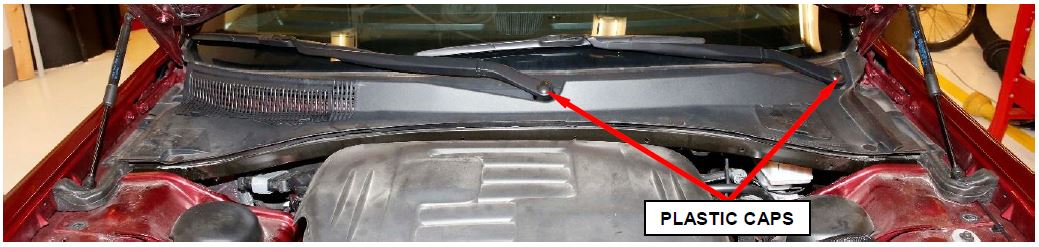
Carefully pry the plastic caps off of the wiper arm pivot nuts (Figure 5).
Figure 5 – Wiper Arm Plastic Caps
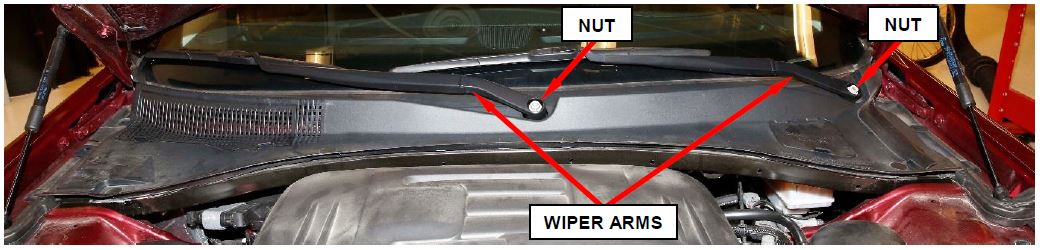
Lift the wiper arm and blade to its over-center position to hold the wiper blade off of the glass and relieve the spring tension on the wiper arm to pivot shaft connection while loosening the wiper arm nuts and removing the wiper arms.
Remove the nuts that secure the wiper arms to the wiper pivot shaft (Figure 5).
NOTE: If necessary, use a suitable battery terminal puller to disengage the wiper arm from the wiper pivot shaft.
Remove both wiper arms from the wiper pivot shaft (Figure 5).
Figure 5 – Wiper Arms and Pivot Shaft Nuts
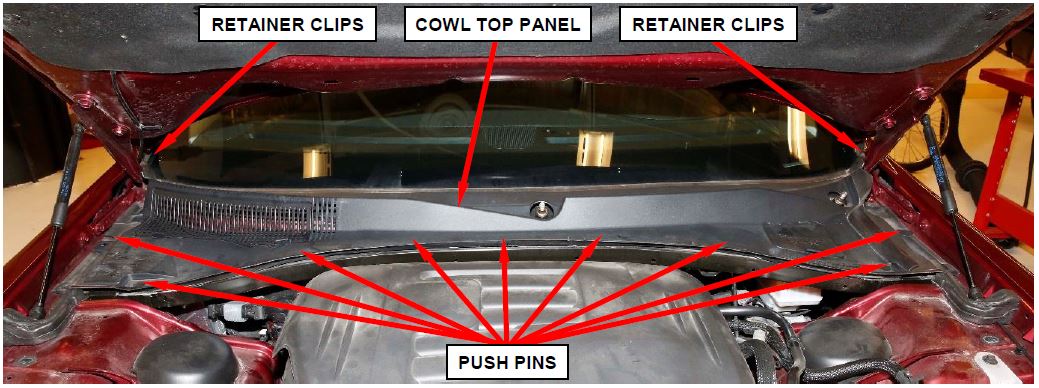
Remove the nine pushpins that secure the cowl top panel (Figure 6).
Disengage the integral retaining clips that secure the cowl top panel to the dash panel and remove the cowl top panel from the engine compartment (Figure 6).
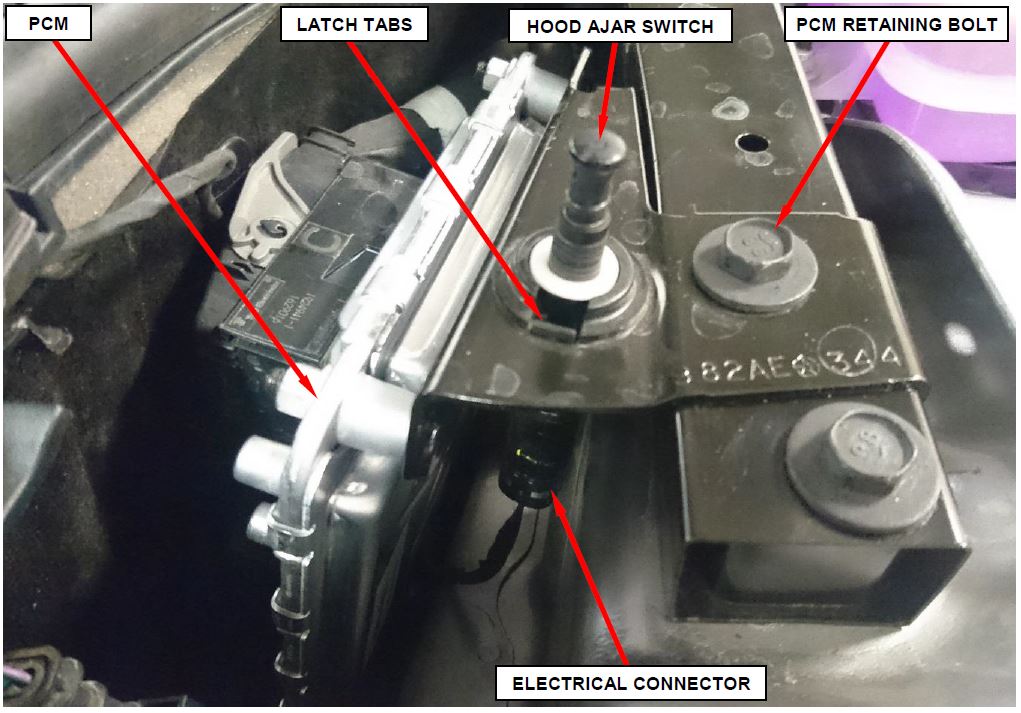
If equipped with hood ajar switch: Working from the top of the PCM mounting bracket on the upper radiator cross member, squeeze the two hood ajar switch latch tabs together far enough to pull the switch upward (Figure 7).
If equipped with hood ajar switch: Pull the hood ajar switch up through the hole in the PCM mounting bracket far enough to access and disconnect the wire harness electrical connector from the switch (Figure 7).
If equipped with hood ajar switch: Remove the hood ajar switch from the vehicle (Figure 7).
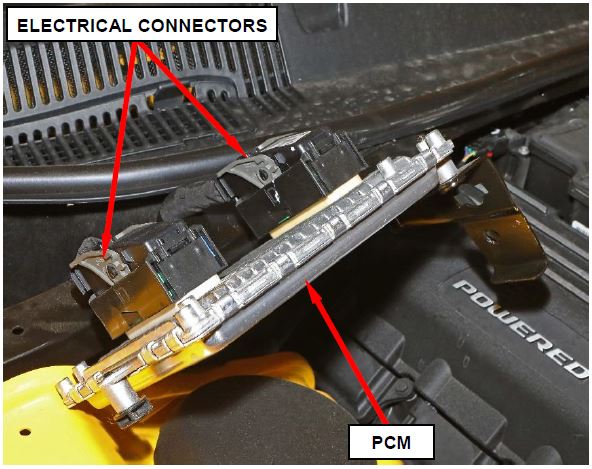
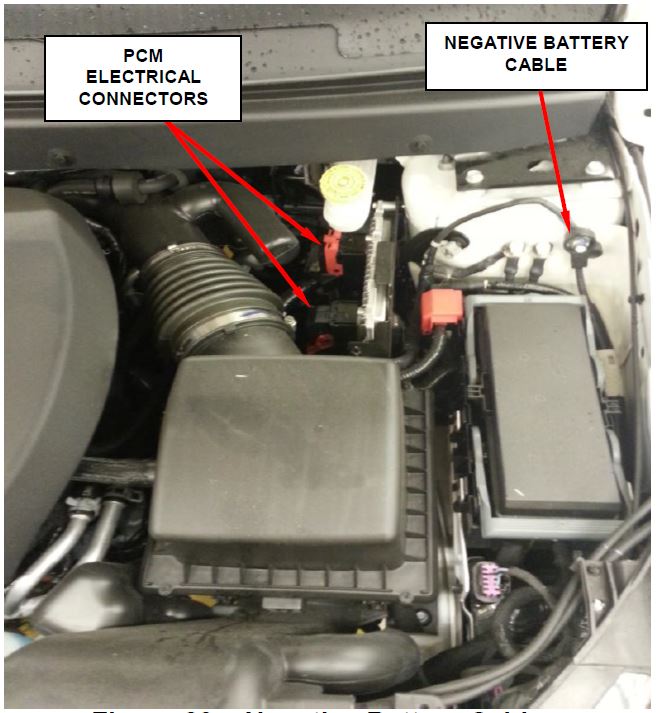
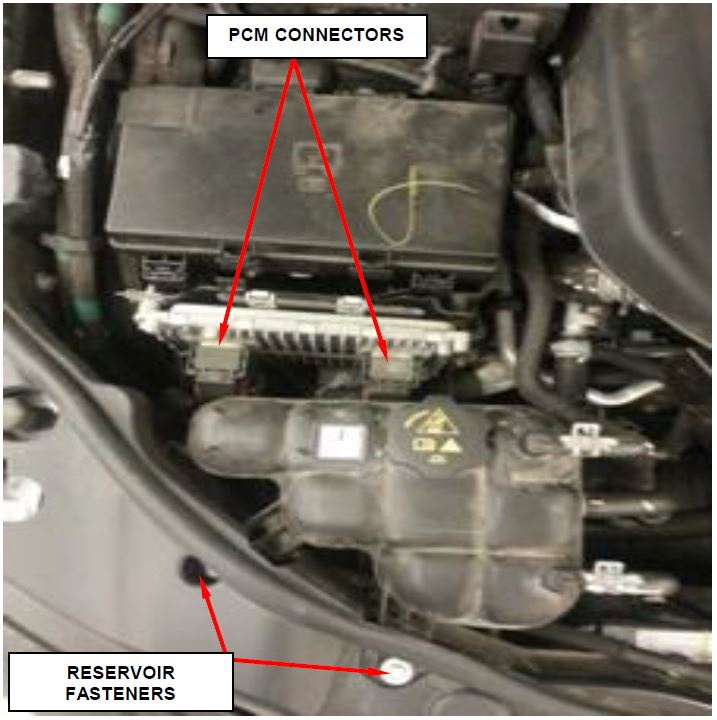
Connect the PCM electrical connectors to the PCM (Figure 8).
Position the PCM bracket to the cross support, install the retaining bolt and tighten to 16 N·m (12 ft. lbs.) (Figure 7).
If equipped with hood ajar switch: Position the hood ajar switch near the switch mounting hole in the PCM mounting bracket on the upper radiator cross member (Figure 7).
If equipped with hood ajar switch: Pull the hood ajar switch wire harness connector through the switch mounting hole and connect it to the hood ajar switch (Figure 7).
If equipped with hood ajar switch: From the top of the mounting bracket, press the hood ajar switch downward into the mounting hole until the two integral switch latch tabs lock it into place (Figure 7).
Close the vehicle hood and return the vehicle to the customer.
.
E. PCM Removal/Installation RU- Hybrid model
Removal
NOTE: Because the high-voltage battery is used to charge the 12-volt battery via the Auxiliary Power Module (APM), disconnecting the 12-volt battery negative cable will not power down the 12-volt system. The following procedure must be performed before any repairs, disassembly, or testing requiring 12-volt power down are carried out.
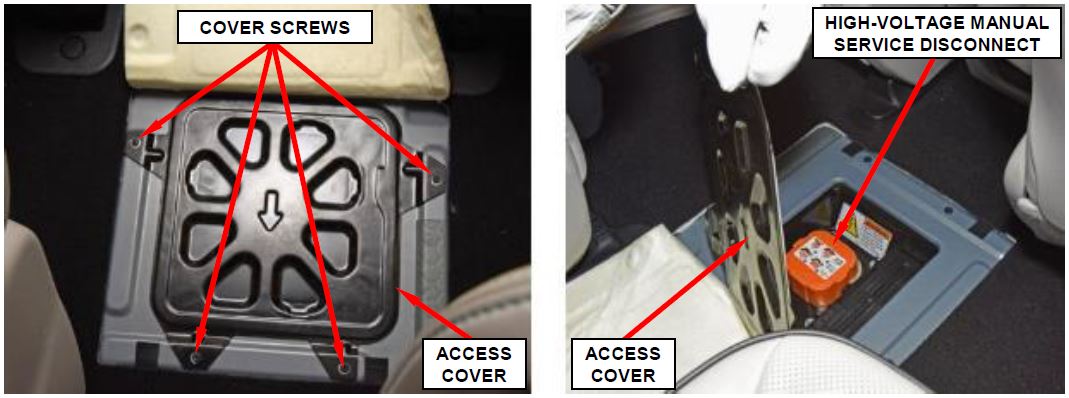
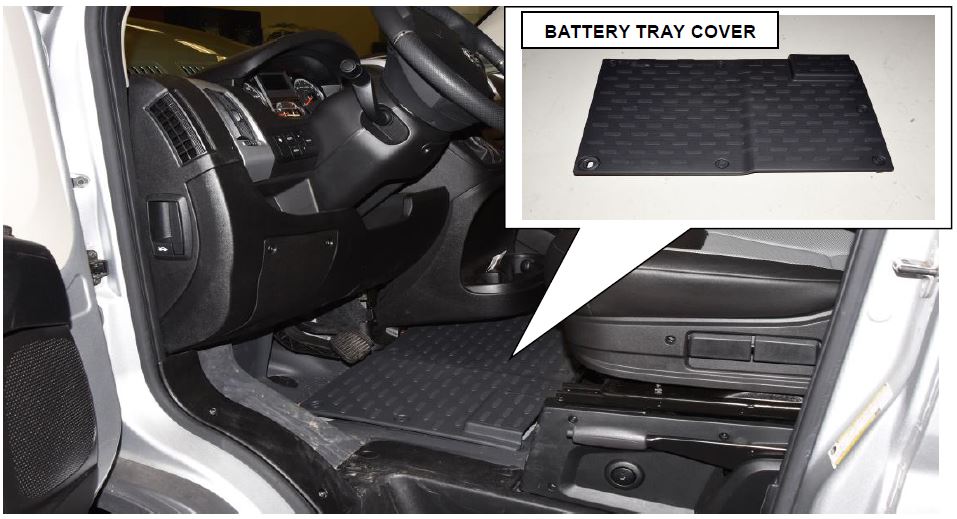
Remove and save the four screws securing the high-voltage manual service disconnect access cover to the floor then remove and save the cover (Figure 13).
Figure 13 – High-Voltage Manual Service Disconnect Access Cover
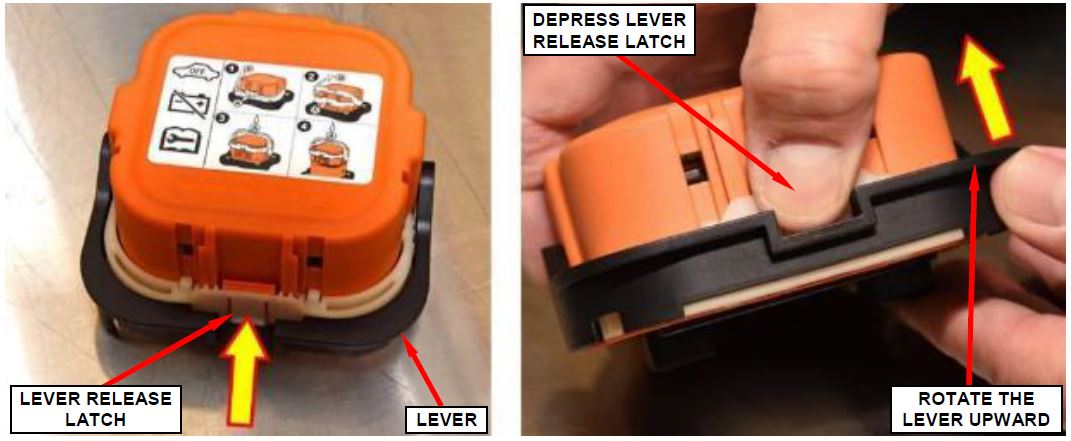
Depress the lever release latch firmly. With the latch fully depressed, rotate the lever upward. The lever will stop at the 45° position (Figure 14).
NOTE: At this stage, the High Voltage Inter-Lock (HVIL) connection has been broken and the circuit is de-energized.
Figure 14 – High-Voltage Manual Service Disconnect First Stage Latch Release (High-Voltage Manual Service Disconnect Removed from Vehicle for Visual Clarity)
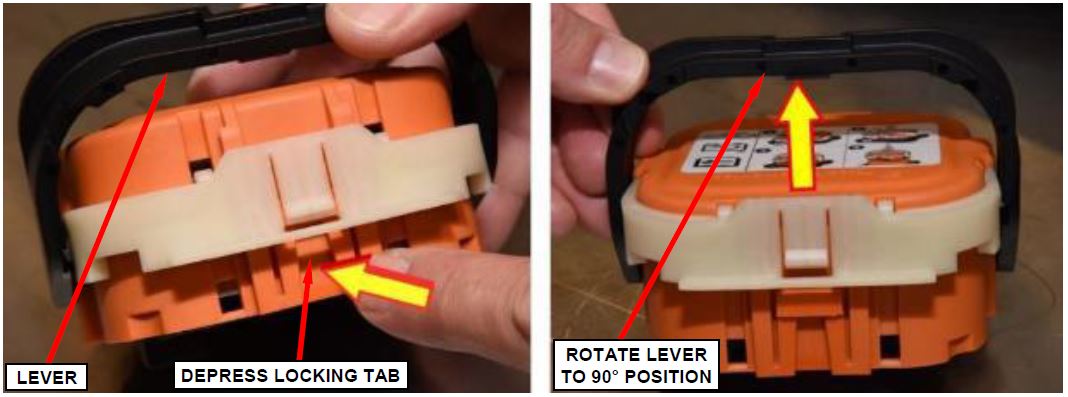
Depress the locking tab and continue to rotate the lever to the end of travel, 90° position (Figure 15).
Figure 15 – High-Voltage Manual Service Disconnect Second Stage Latch Release (High-Voltage Manual Service Disconnect Removed from Vehicle for Visual Clarity)
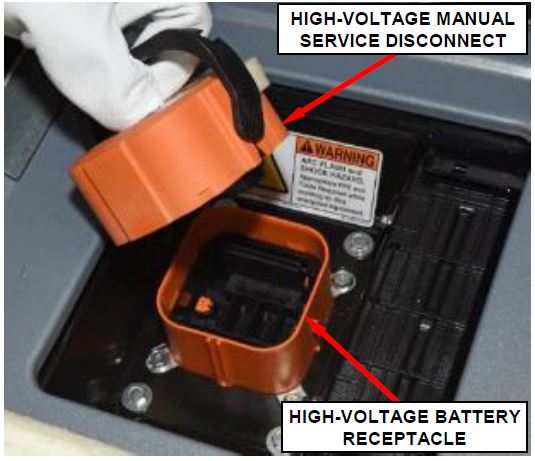
Pull straight up on the service disconnect lever to disengage and remove the high-voltage manual service disconnect from the receptacle (Figure 16).
Figure 16 – High-Voltage Manual Service Disconnect and Receptacle
NOTE: Make sure the location of the high-voltage manual service disconnect is always known after removal. It is best practice to place the high-voltage manual service disconnect in a highly visible location when removed.
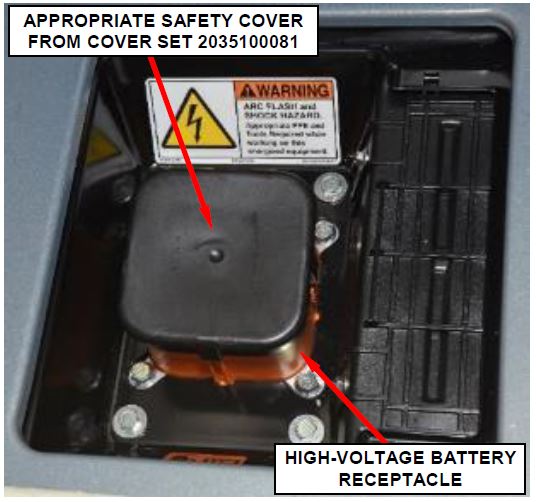
Cap the receptacle on the high-voltage battery with the appropriate cover found in safety cover set 2035100081 to prevent foreign objects from entering the receptacle (Figure 17).
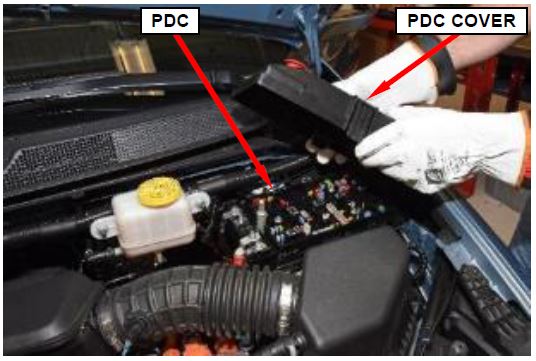
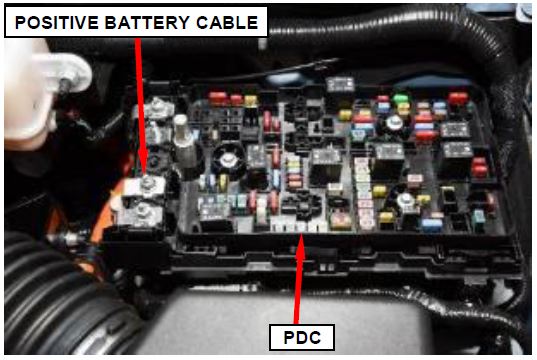
Check the 12-Volt system at the Power Distribution Center (PDC) with a multimeter to assure that there is less than 1-Volt present. If so, the 12-volt electrical system is now powered down.
h. Select “Learn ETC” and follow the on screen instructions. When complete, select “Finish”.
i. Select “Check PCM Odometer” and follow the on screen instructions. When complete, select “Finish”.
j. Perform the “Brake Pedal Learn” procedure as follows:
k. Park the vehicle on level ground.
NOTE: When performing the Brake Pedal Calibration Learn routine, make sure the brake pedal is NOT pressed.
NOTE: Not all PCMs support the Brake Pedal Learn. If the PCM supports it the routine will be available.
With the scan tool, under the PCM “Miscellaneous Functions” menu, select and run the “Brake Pedal Learn” routine.
Select “Total Linear Compensation (TLC) learn”, follow screen prompts to “finish”.
NOTE: Engine temperature must be at 150 (F) (65 C) degrees before the TLC learn routine is performed, hood must be open in order for the engine to start and not be in the “electric” mode.
Clear all DTC’s.
Place the ignition in the “OFF” position and then remove the wiTECH micro pod II device from the vehicle.
NOTE:Programming the PCM or WIN is done using the diagnostic scan tool and a PIN to enter secure access mode. If three attempts are made to enter secure access mode using an incorrect PIN, secure access mode will be locked out for one hour. To exit this lockout mode, turn the ignition to the RUN position for one hour and then enter the correct PIN. Be certain that all accessories are turned OFF. Also, monitor the battery state and connect a battery charger if necessary.
CAUTION: Read all notes and cautions for programming procedures.
Obtain vehicle PIN follow procedure below.
a. From the home page on DealerCONNECT select the “Service” tab
b. From the “Repair Information” section select “Key Code”.
c. Enter the VIN, the reason and agree.
d. The PIN will be displayed, record this numbers for later use.
a. Select “Learn ETC” and follow the on screen instructions. When complete, select “Finish”.
b. Select “Check PCM Odometer” and follow the on screen instructions. When complete, select “Finish”.
Clear all DTC’s.
Place the ignition in the “OFF” position and then remove the wiTECH micro pod II device from the vehicle.
Remove the battery charger from the vehicle.
Close the vehicle hood and return the vehicle to the customer.
.
G. PCM Removal/Installation DS/DX models.
CAUTION: Certain ABS systems rely on having the Powertrain Control Module (PCM) broadcast the Vehicle Identification Number (VIN) over the bus network. To prevent problems of DTCs and other items related to engine main menu. Arrow over to the second page to “1. Miscellaneous”. the VIN broadcast, it is recommended that you disconnect the ABS CAB (controller) temporarily when replacing the PCM. Once the PCM is replaced, write the VIN to the PCM using a scan tool. This is done from the Select “Check VIN” from the choices. Make sure it has the correct VIN entered before continuing. When the VIN is complete, turn off the ignition key and reconnect the ABS module connector. This will prevent the setting of DTCs and other items associated with the lack of a VIN detected when you turn the key ON after replacing the PCM.
CAUTION: Use the scan tool to reprogram the new PCM with the vehicles original identification number (VIN) and the vehicles original mileage. If this step is not done, a Diagnostic Trouble Code (DTC) may be set.
Removal
Disconnect the negative battery cable.
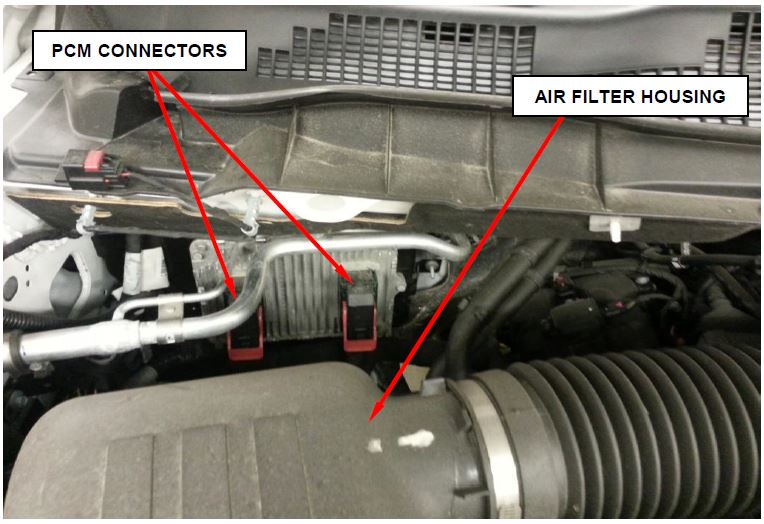
Carefully disconnect the electrical connectors from the PCM (Figure 22).
a. Select “Check PCM VIN” and follow the on screen instructions. When complete, select “Finish”.
b. Select “Learn ETC” and follow the on screen instructions. When complete, select “Finish”.
c. Select “Check PCM Odometer” and follow the on screen instructions. When complete, select “Finish”.
d. Perform the “Brake Pedal Learn” procedure as follows:
I. Park the vehicle on level ground.
NOTE: When performing the Brake Pedal Calibration Learn routine, make sure the brake pedal is NOT pressed.
NOTE: Not all PCMs support the Brake Pedal Learn. If the PCM supports it, the routine will be available.
II. With the scan tool, under the PCM “Miscellaneous Functions” menu, select and run the “Brake Pedal Learn” routine.
Clear all DTC’s.
Place the ignition in the “OFF” position and then remove the wiTECH micro pod II device from the vehicle.
Remove the battery charger from the vehicle.
Close the vehicle hood and return the vehicle to the customer.
.
H. PCM Removal/Installation (BU) Jeep Renegade, (FB) Fiat 500X, (MP) Jeep Compass models.
Removal
Disconnect and isolate the negative battery cable. If equipped with an Intelligent Battery Sensor (IBS), disconnect the IBS connector first before disconnecting the negative battery cable.
Connect the negative battery cable and tighten nut to 5 N·m (45 in. lbs.). If equipped with an Intelligent Battery Sensor (IBS), connect the IBS connector.
MP, BU, FB Models – Perform the “Proxy Configuration Alignment” located in the “Vehicle Preparations” menu in the Body Control Module (BCM). This routine will copy the PROXI into the PCM and write the PCM VIN.
MP, Models – Select and run the “ECM” in “miscellaneous functions”, and perform the “PCM/ECM/ESL replace” routine. Verify that the PCM states programmed after it transfers the immobilizer data.
MP, Model – Perform the “ETC” test.
BU, FB Models – Obtain PIN by following the steps below.
a. From the home page on DealerCONNECT select the “Service” tab
b. From the “Repair Information” section select “Key Code”.
c. Enter the VIN, the reason and agree.
d. The PIN will be displayed, record this numbers for later use.
BU, FB Models – Navigate to the BCM “ Functions” menu and perform the “Transfer Secret Key to ESL ECM” routine. Enter PIN when requested.
BU, FB Models – Verify that the engine starts and runs.
BU, FB Models – In the PCM “ Functions” menu, select and run the “Learn ETC” routine. This routine is necessary to learn the throttle position voltages and the accelerator pedal position. Follow the prompts shown on the diagnostic scan tool.
BU, FB Models – In the PCM “ Functions” menu, perform the “Cruise Control Learn” routine. Follow the prompts shown on the diagnostic scan tool
Clear all DTC’s.
Place the ignition in the “OFF” position and then remove the wiTECH micro pod II device from the vehicle.
Remove the battery charger from the vehicle.
Close the vehicle hood and return the vehicle to the customer.
.
I. PCM Removal/Installation (JC) Dodge Journey model.
Removal
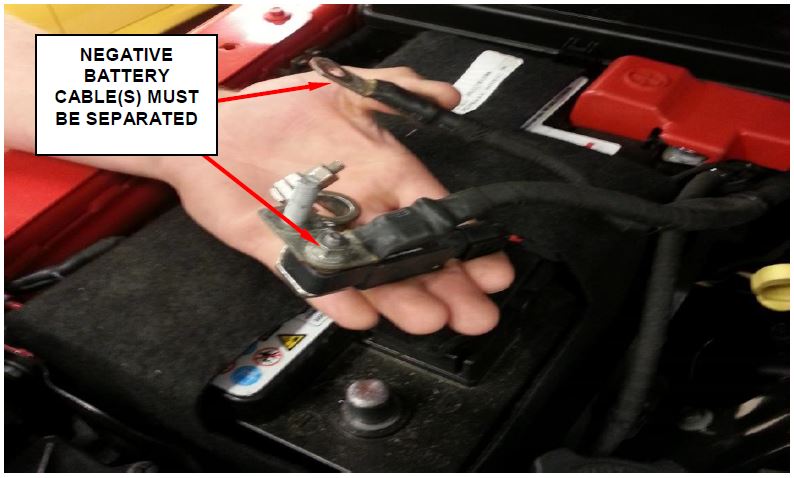
Disconnect and isolate the negative battery cable (Figure 23).
Figure 23 – Negative Battery Cable
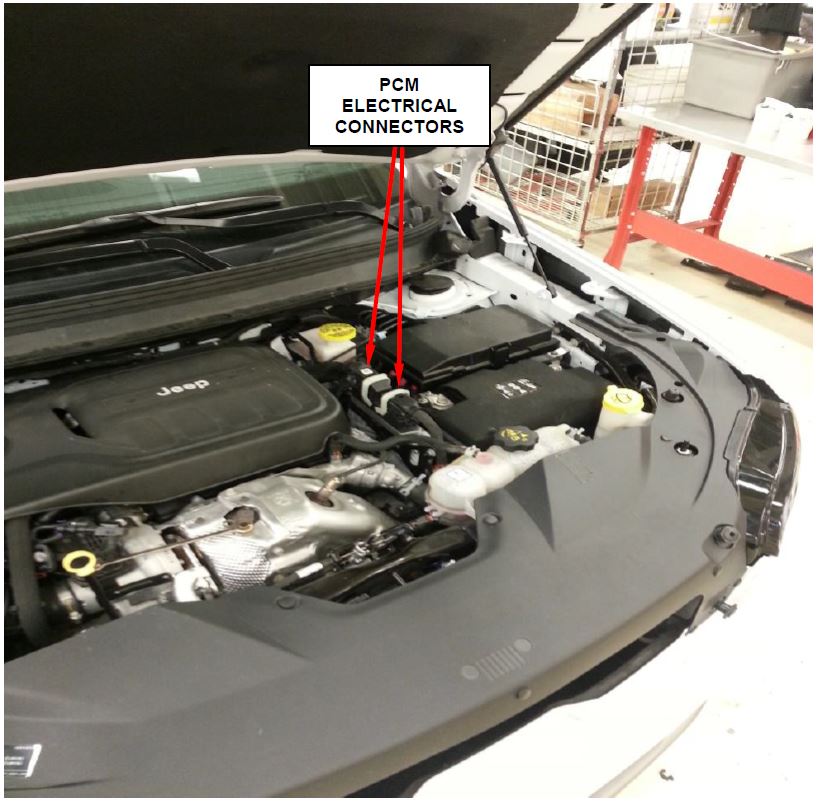
Unlock and disconnect the two electrical connectors at the PCM (Figure 23).
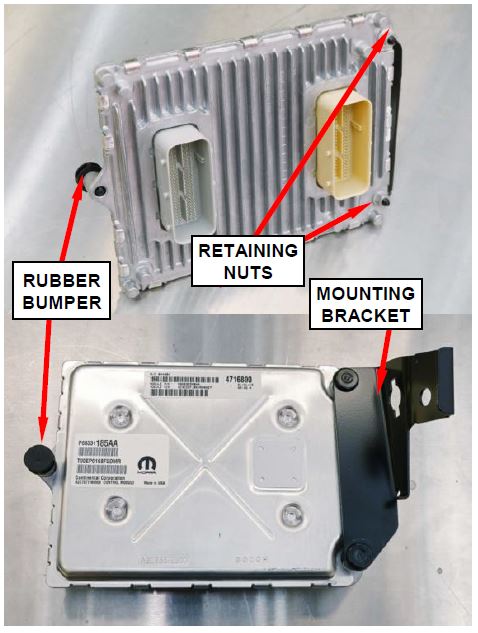
Remove the four bolts holding the PCM to the bracket and remove the PCM from the vehicle.
a. Select “Check PCM VIN” and follow the on screen instructions. When complete, select “Finish”.
b. Select “Learn ETC” and follow the on screen instructions. When complete, select “Finish”.
c. Select “Check PCM Odometer” and follow the on screen instructions. When complete, select “Finish”.
d. Perform the “Brake Pedal Learn” procedure as follows:
e. Park the vehicle on level ground.
NOTE: When performing the Brake Pedal Calibration Learn routine, make sure the brake pedal is NOT pressed.
NOTE: Not all PCMs support the Brake Pedal Learn. If the PCM supports it, the routine will be available.
Place the ignition in the “OFF” position and then disconnect the wiTECH micro pod II device from the vehicle diagnostics port, close all doors allow the bus to go to sleep.
Reconnect the micro pod II to the vehicle diagnostics port start wiTECH and clear all DTC’s.
Remove the battery charger from the vehicle.
Close the vehicle hood and return the vehicle to the customer.
.
L. PCM Removal/Installation (RU) Chrysler Pacifica model.
Removal
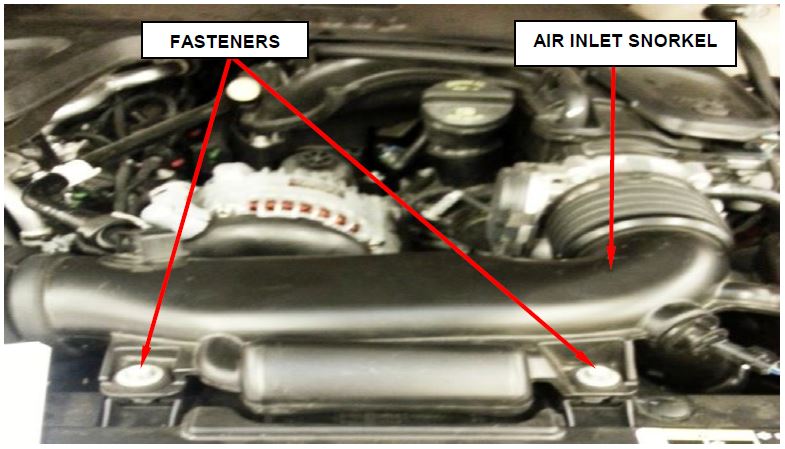
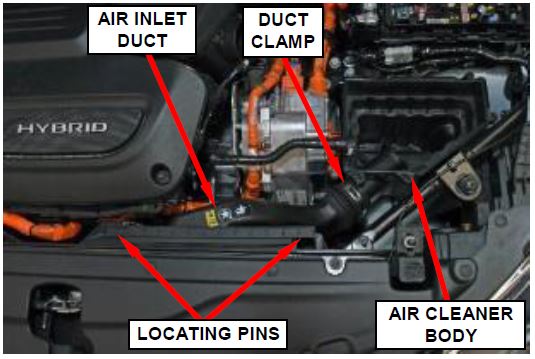
Disengage the retainers and remove the air inlet duct.
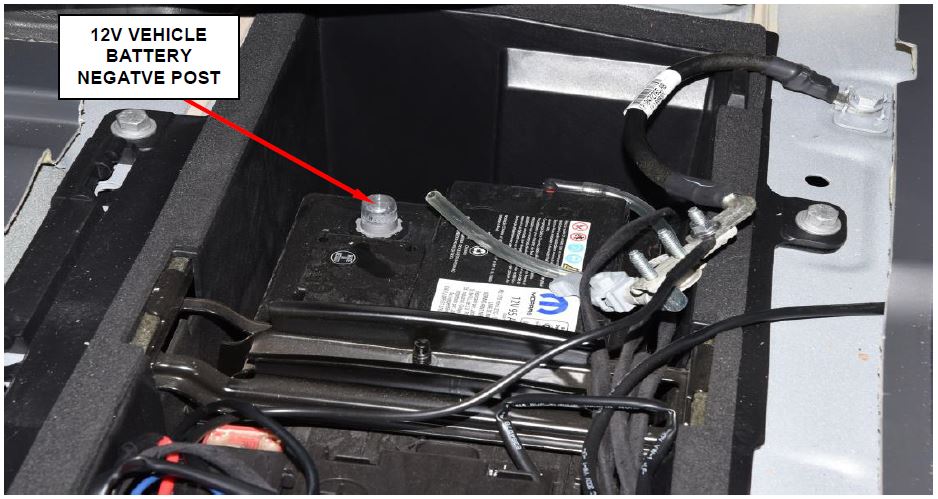
Disconnect the 12v and if equipped the auxiliary negative battery cable(s).
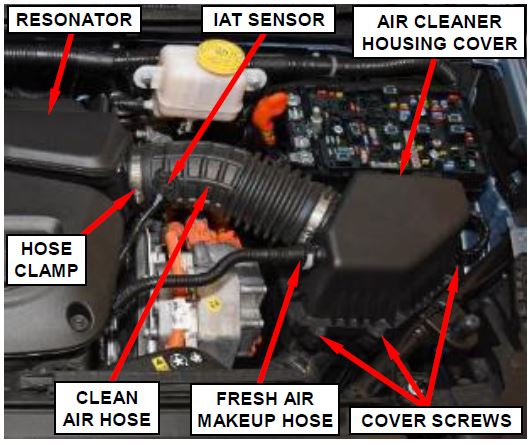
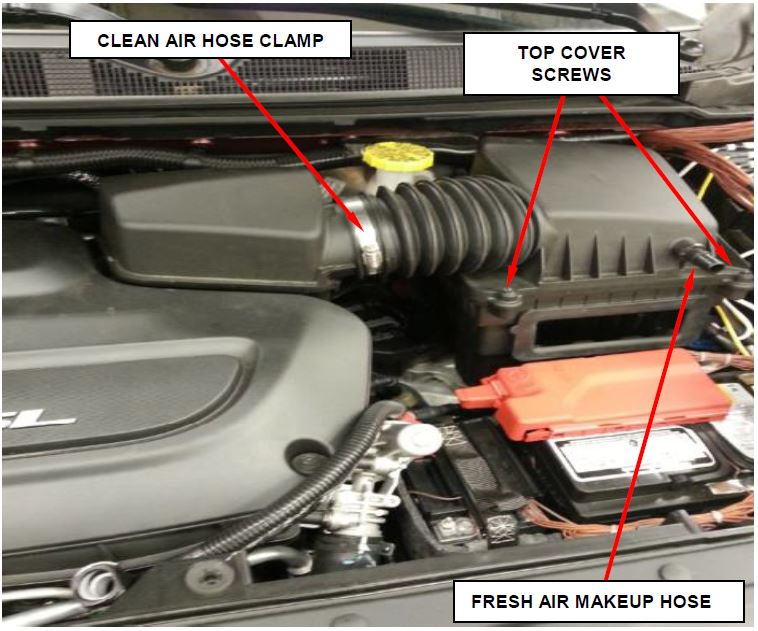
Disconnect the fresh air makeup hose from the air cleaner body (Figure 27).
Figure 27 – Air Cleaner Housing
Loosen the clean air hose clamp and disengage the clean air hose from the resonator (Figure 27).
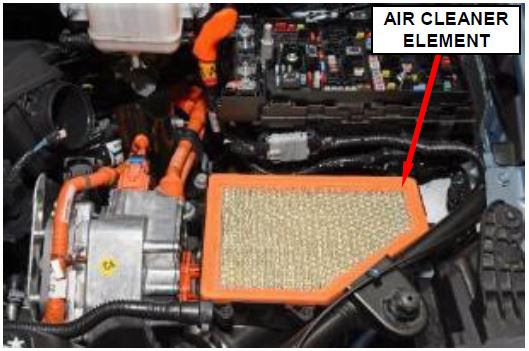
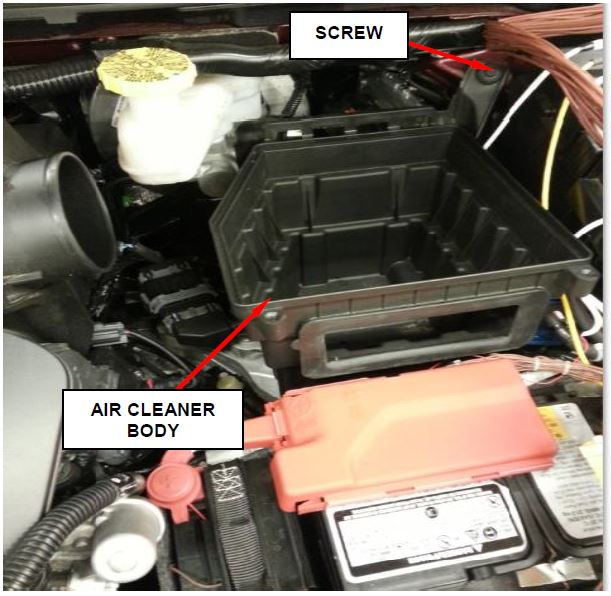
Loosen the cover screws and remove the air cleaner housing cover (Figure 28).
Remove the air cleaner element.
Figure 28 – Air Cleaner
Remove the screw and pull the air cleaner body straight up to disengage the locating stud from the rubber mount (Figure 28).
a. From the home page on DealerCONNECT select the “Service” tab
b. From the “Repair Information” section select “Key Code”.
c. Enter the VIN, the reason and agree.
d. The PIN will be displayed, record this numbers for later use.
From the “Topology” screen, select “PCM”
Select “ functions”
a. Select “Check PCM VIN” and follow the on screen instructions. When complete, select “Finish”.
b. Select “Learn ETC” and follow the on screen instructions. When complete, select “Finish”.
c. Select “Check PCM Odometer” and follow the on screen instructions.
d. From “Topology” screen and select the Body Control Module (BCM).
e. Select the “ Functions” menu.
f. Run the “Immobilizer ECU Replace” routine.
g. From the “Topology” screen, select “PCM”.
h. Select “ functions”
i. Perform the “Brake Pedal Learn” procedure as follows:
j. Park the vehicle on level ground.
NOTE: When performing the Brake Pedal Calibration Learn routine, make sure the brake pedal is NOT pressed.
NOTE: Not all PCMs support the Brake Pedal Learn. If the PCM supports it the routine will be available.
Clear all DTC’s.
Place the ignition in the “OFF” position and then remove the wiTECH micro pod II device from the vehicle.
Remove the battery charger from the vehicle.
Close the vehicle hood and return the vehicle to the customer.
Complete Proof of Correction Form for California Residents
This recall is subject to theState of California Registration Renewal/EmissionsRecall Enforcement Program. Complete a Vehicle Emission Recall Proof of Correction Form (Form No. 81-016-1053) and supply it to vehicle owners residing in the state of California for proof that this recall has been performed when they renew the vehicle registration.
Process Steps to obtain the California Proof of Correction form:
a. Access the “DealerCONNECT” website.
b. Select the “Service” tab.
c. Under the “Publications” heading, select the “ePublishing” link.
d. Sign in using your Dealer Code and Password.
e. Select the “Proof of Correction form”.
Completion Reporting and Reimbursement
Claims for vehicles that have been serviced must be submitted on the DealerCONNECT Claim Entry Screen located on the Service tab. Claims paid will be used by FCA to record recall service completions and provide dealer payments.
Use one of the following labor operation numbers and time allowances:
Labor Operation Number
Time Allowance
Replace PCM and Program JC, JK, VF, LA Models
08-U8-71-82
0.4 hours
Replace PCM and Program KL, FB, MP, DS, DX, WK, WD, BU, LX, LD RU-Non Hybrid
08-U8-71-83
0.5 hours
Replace and Program PCM RT 3.6L, JL 3.6L Model
08-U8-71-84
0.6 hours
Replace and Program PCM JL 2.0L Model
08-U8-71-85
0.7 hours
Replace and Program PCM RU – HybridModel
08-U8-71-86
1.2 hours
Floor Plan Reimbursement
95-95-95-97
Calculate
See Below
Floor Plan Reimbursement
Floor Plan Reimbursement represents the vehicle’s average daily allowance (see table below) multiplied by the number of days the vehicle was in dealer inventory and not available for sale. This reimbursement is limited to the number of days from the date of the stop sale to the date that the remedy was made available. Note: If the vehicle was received by your dealership (KZX date) AFTER the stop sale date, you will use the KZX date instead of the stop sale date. For this Recall, the stop sale was initiated on 08/16/2018 and the remedy was made available on 09/27/2018, therefore, the number of days cannot exceed 42 days.
Vehicle
Average Daily Allowance
2017-2018 (JK) Jeep Wrangler
2018 (JL) Jeep Wrangler
2018 – 2019 (KL) Jeep Cherokee
2018 (LA) Dodge Challenger
2018 (LD) Dodge Charger
2017-2018 (RT) Dodge Caravan
2018 (RU) Chrysler Pacifica
2018 (DS) RAM 1500 Pickup
2018 (BU) Jeep Renegade
2018 (FB) Fiat 500X
2018 (JC) Dodge Journey
2018 (LX) Chrysler 300
2018 (MP) Jeep Compass
2018 (VF) RAM Promaster
2018 (WD) Dodge Durango
2018 (WK) Jeep Grand Cherokee
NOTE: See the Warranty Administration Manual, Recall Claim Processing Section, for complete recall claim processing instructions.
Dealer Notification
To view this notification on DealerCONNECT, select “Global Recall System” on the Service tab, then click on the description of this notification.
Owner Notification and Service Scheduling
All involved vehicle owners known to FCA are being notified of the service requirement by first class mail. They are requested to schedule appointments for this service with their dealers. A generic copy of the owner letter is attached.
Vehicle Lists, Global Recall System, VIP and Dealer Follow Up
All involved vehicles have been entered into the DealerCONNECT Global Recall System (GRS) and Vehicle Information Plus (VIP) for dealer inquiry as needed.
GRS provides involved dealers with an updated VIN list of their incomplete vehicles. The owner’s name, address and phone number are listed if known. Completed vehicles are removed from GRS within several days of repair claim submission.
To use this system, click on the “Service” tab and then click on “Global Recall System.” Your dealer’s VIN list for each recall displayed can be sorted by: those vehicles that were unsold at recall launch, those with a phone number, city, zip code, or VIN sequence.
Dealers must perform this repair on all unsold vehicles before retail delivery. Dealers should also use the VIN list to follow up with all owners to schedule appointments for this repair.
Recall VIN lists may contain confidential, restricted owner name and address information that was obtained from the Department of Motor Vehicles of various states. Use of this information is permitted for this recall only and is strictly prohibited from all other use.
Additional Information
If you have any questions or need assistance in completing this action, please contact your Service and Parts District Manager.
Customer Services / Field Operations
FCA US LLC
This notice applies to your vehicle,
[Model Year and Model] VIN XXXXXXXXXXXXXXXXX
U87/NHTSA 18V-524
LOGO
VEHICLE PICTURE
YOUR SCHEDULING OPTIONS
RECOMMENDED OPTION Call your authorized Chrysler / Dodge / Jeep/ RAM Dealership
Call the FCA Recall Assistance Center at 1-800-853-1403. An agent can confirm part availability and help schedule an appointment
Visit recalls.mopar.com, scan the QR code below, or download the Mopar Owner’s Companion App.
Get access to recall notifications, locate your nearest dealer, and more through this website or Mopar Owner’s Companion App. You will be asked to provide your Vehicle Identification Number (VIN) to protect and verify your identity. The last eight characters of your VIN are provided above.
This notice is sent to you in accordance with the National Traffic and Motor Vehicle Safety Act.
FCA has decided that a defect, which relates to motor vehicle safety, exists in certain [2017 – 2018 (JK) Jeep Wrangler, 2018 (JL) Jeep Wrangler, 2018 – 2019 (KL) Jeep Cherokee, 2018 (LA) Dodge Challenger, 2018 (LD) Dodge Charger, 2017 – 2018 (RT) Dodge Caravan/Chrysler Town & Country, 2018 (RU) Chrysler Pacifica, 2018 (DS) RAM 1500 Pickup, 2018 (BU) Jeep Renegade, 2018 (FB) FIAT 500X, 2018 (JC) Dodge Journey, 2018 (LX) Chrysler 300, 2018 (MP) Jeep Compass, 2018 RAM Promaster, 2018 (WD) Dodge Durango, 2018 (WK) Jeep Grand Cherokee] vehicles equipped with a 2.0L, 2.4L,3.2L ,3.6L, or 5.7L engine.
It is extremely important to take steps now to repair your vehicle to ensure the safety of you and your passengers.
WHY DOES MY VEHICLE NEED REPAIRS?
The Powertrain Control Module (PCM) on your vehicle [1] may have been manufactured with a suspect voltage regulator chip on the electronic circuit board. If the powertrain control module fails, you may experience a no-start, a start-and-immediate stall condition, or an engine stall while driving. An engine stall while driving resulting in loss of motive power can cause vehicle crash without prior warning.
HOW DO I RESOLVE THIS IMPORTANT SAFETY ISSUE?
FCA will repair your vehicle [2] free of charge (parts and labor). To do this, your dealer will replace and program the Powertrain Control Module. In addition, your dealer will require your vehicle for proper check-in, preparation, and check-out during your visit. Your timeis important to us; please be aware that these steps may require more time. The estimated repair time is one hour. We recommend that you schedule a service appointment to minimize your inconvenience. Please bring this letter with you to your dealership.
TO SCHEDULE YOUR FREE REPAIR CALL YOUR CHRYSLER, DODGE, JEEP OR RAM DEALER TODAY
CALIFORNIA RESIDENTS
The State of California requires the completion of emission recall repairs prior to vehicle registration renewal. Your dealer will provide you with a Vehicle Emission Recall Proof of Correction Form after the Emission Recall service is performed. Be sure to save this form since the California Department of Motor Vehicles may require that you supply it as proof that the Emission Recall has been performed.
In order to ensure your full protection under the emissions warranty provisions, it is recommended that you have your vehicle serviced as soon as possible. Failure to do so could be determined as lack of proper maintenance of your vehicle.
WHAT IF I ALREADY PAID TO HAVE THIS REPAIR COMPLETED?
If you have already experienced this specific condition and have paid to have it repaired, you may visit www.fcarecallreimbursement.comto submit your reimbursement request online. [3] Once we receive and verify the required documents, reimbursement will be sent to you within 60 days. If you have had previous repairs performed and/or already received reimbursement, you may still need to have the recall repair performed.
We apologize for any inconvenience, but are sincerely concerned about your safety. Thank you for your attention to this important matter.
Customer Assistance/Field Operations FCA US LLC
Mr. Mrs. Customer 1234 Main Street Hometown, MI 48371
[1] If you no longer own this vehicle, please help us update our records. Call the FCA Recall Assistance Center at 1-800-853-1403 to update your information.
[2] If your dealer fails or is unable to remedy this defect without charge and within a reasonable time, you may submit a written complaint to the Administrator, National Highway Traffic Safety Administration, 1200 New Jersey Ave., S.E., Washington, DC 20590, or you can call the toll-free Vehicle Safety Hotline at 1-888-327-4236 (TTY 1-800-4249153), or go to safercar.gov.
[3] You can also mail in your original receipts and proof of payment to the following address for reimbursement consideration: FCA Customer Assistance, P.O. Box 21-8004, Auburn Hills, MI 48321-8007, Attention: Recall Reimbursement.
Note to lessors receiving this recall notice: Federal regulation requires that you forward this recall notice to the lessee within 10 days.
* Chrysler recommends the CTC Vehicle Box Device for Chrysler SCI ECU reprogramming. SCI reprogramming is used on most PCMs and TCMs prior to the introduction of CAN bus vehicles which began in 2004 (Durango).
Click on the link below to:
Download J2534 Application
(Install the wiTECH 2.0 J2534 Application on your computer)
Download the Setup Utility
(Configure your microPod/MDP device)
Launch wiTECH 2.0
(Once subscription and users are assigned to a tool please follow this link to access wiTECH)
J2534 Pass-Thru Programmer: TOPDON RLink J2534 is an advanced diagnostic and reprogramming tool that support all J2534 protocols, as well as D-PDU, CAN-FD and DoIP, ensuring compatibility with a wide range of modern vehicles. It offers extensive versatility with support for over 18 major automotive brands, including Chrysler, Ford, GM, Nissan, Toyota, Honda, Subaru, Land Rover/Jaguar, Volvo, Wuling, Volkswagen/Audi, Mercedes-Benz, and BMW. NOTE: Not compatible with Ford IDS diagnostic software
All-in-One OEM Diagnostics: This J2534 ECU programming tool elevates your automotive repair capabilities to new heights by delivering complete OEM diagnosis. Boasting comprehensive full-system diagnostics, intuitive repair guides, advanced ECU programming and coding, common reset services, a vast library of repair information and more, this all-in-one solution empowers technicians to effortlessly tackle complex vehicle issues with ease. *Not compatible with 24V vehicles
Proven Performance You Can Trust: Backed by over 10000 real vehicle tests and benefit from a wealth of practical experience, this OEM reprogramming tool guarantees stable and exceptional performance. Supported by TOPDON's dedicated technical experts with in-depth knowledge of both auto repair and J2534 Pass-Thru programming, the RLink J2534 provides prompt and professional assistance, ensuring a smooth setup and reliable compatibility
Integrated Excellence, Always Up-to-Date: Featuring the exclusive RLink Platform to provide a streamlined experience with one-click driver installation and management, ensuring flawless integration with your OE software, maintaining the original performance quality. The built-in operation guide makes mastering OE software quick and easy, so you can get started right away. Plus, with lifetime free updates, your diagnostics will stay current with the latest drivers and innovations
Efficiency Meets Versatility: Engineered to support three CAN channels simultaneously - CAN FD and CAN-CC included, giving you the edge in fast troubleshooting. To perfectly synchronized with the OE software, please diagnose with active subscriptions and make sure your computer system is running a compatible 64-bit Windows version (7, 8, 10 or later) to fully leverage the power of RLink J2534. *We don't provide extra OE software
Advanced VCI Box, Industry-leading J2534 Pass-Thru Technology: This J2534 Pass-Thru Programmer is designed espically for technicians, independent shop owners, and DIY enthusiasts, enables fast, reliable computer-based programming. It supports all J2534 protocols—including the latest DoIP and CAN FD—ensuring full compatibility with both legacy and next-generation vehicles.
High-Speed OEM-Level Diagnostics & Programming: Unlock true OEM functionality with comprehensive system diagnostics, guided troubleshooting, coding, adaptations, resets, and programming—all designed to slash repair time. This all-in-one tool eliminates the need for multiple OEM devices, boosting efficiency and cutting costs. Equipped with High-Speed USB, it delivers 10x more data per second than competing solutions
Coverage for 17 Car Brands & Ultra Reliability: Works seamlessly for Chrysler, for Ford(Forscan), for GM, for Nissan, for Toyota, for Honda, for Subaru(SSM4), for Land Rover/Jaguar, for Volvo, for Wuling, for Volkswagen, for Mercedes-Benz, and for BMW. Backed by over 10000 real vehicle tests and benefit from a wealth of practical experience, this OEM reprogramming tool guarantees stable and exceptional performance
User-Friendly RLink Platform & Expert Support: TOPDON’s proprietary driver management platform offers a clean interface and lifetime free updates. Access a rich library of real-world case studies to stay ahead of the curve. Backed by a support team with 10+ years of J2534 and automotive repair experience, we provide one-on-one assistance to resolve any technical issue.
6.6 ft USB-C Cable & Portable Storage Case: The RLink J2534 diagnostic tool features a 6.6ft USB 2.0 Cable and a 1.2 ft OBDII Extension Cable, allows to connection your computer easily outside the vehicle. The included handled carry case offers easy portability, storage, and hanging options—keeping your gear clean and ready to go, anywhere.
Dual WiFi & 10.1" Touchscreen: Provides a stable, high-speed wireless link 3x faster than bluetooth, and a responsive, professional interface. Topdon ONE obd2 scanner diagnostic tool ensures smooth, non-lagging diagnostic scan, boosting mechanic efficiency
J2534 Pass-Thru Support: The included ONE VCI supports the J2534 standard, allowing it to function as a pass-thru device when paired with OEM diagnostic software.Through TOPDON’s RLink platform, technicians can perform dealer-level coding, expanding in-house capabilities without investing in multiple factory automotive scan tools
OE Topology Mapping: Visualize the vehicle’s ECU network exactly as it’s built.Zoom, pan, and highlight specific modules to pinpoint component issues with precision.Topology mapping displays real-time communication between modules
50+ Service Functions: Covers high-demand services like ADAS calibration, DPF regen, TPMS reset, ABS bleed, and throttle adaptation.Expands your service menu, allows you to charge premium rates, and turns away zero jobs due to lack of tooling. Vehicle-specific functionality may vary
Advaned ECU Coding: 10 of the most serviced brands in North America, including full ECU coding and flash hidden support for BMW, VW, Au-di, Benz, Porsche, Toyota, Ni ssan and more. Enables module replacement, feature customization, and personal settings with automatic backup or restore.Lets your shop safely offer high-margin customization services, attracting more customers and boosting profit
[J2534 Pass-Thru Programmer] - TOPDON RLink J2534 is engineered for professional technicians, delivering OEM diagnostic and reprogramming capabilities. It supports all J2534 protocols, CAN-FD, DoIP, D-PDU. Compatible with 17 vehicle brands—such as Chrysler, Ford, GM, KIA, Hyundai, Nissan, Toyota, Honda, Subaru, Mitsubishi, MAZDA, Land Rover/Jaguar, Volvo, Volkswagen/Audi, Mercedes-Benz, and BMW. RLink J2534 can help reduce the cost of purchasing equipment from different brands.
[All-in-One OEM Reprogramming and Diagnostics] - When seamlessly integrated with OEM diagnostic software, this dongle enables you to perform a wide range of functions, including ECU programming and coding, DTC reading and clearing, active tests, component matching, adaptations, rewriting, guided troubleshooting, and more. This all-in-one tool eliminates the need for multiple OEM devices, significantly boosting work efficiency.
[Tested, Trusted, and Proven for Accuracy] - TOPDON RLink J2534 is renowned for its reliability, having successfully completed over 10,000 real-vehicle tests. The wealth of data and hands-on experience behind it ensures consistent performance and accurate results. You can trust this tool to deliver optimal performance.
[One-Click Installation, Continuous Updates] - The exclusive TOPDON RLink platform streamlines installation with a one-click driver setup, allowing you to quickly access OEM software for diagnostic and reprogramming tasks. With lifetime free updates, your RLink J2534 stays current without any additional cost, ensuring reliable performance for the long term. *We don't provide extra OE software.
[Works with Windows Compatibility and OEM Software Subscription] - The RLink J2534 supports three CAN channels - including CAN FD and CAN-CC, providing advantages in the process of rapid troubleshooting. Compatible with Windows 7, 8 and 10 (64-bit) and higher versions of the system. For full functionality, an active OEM software subscription is required for each supported vehicle brand. Please note that the dongle does not include OEM software, which must be purchased separately to access brand-specific diagnostic and reprogramming features.
💯【Conta.ct us for Support Directly】For any issues experienced after purchase, please reach out to: 📞autelsupply@ outlook. com🛣️. Our team will provide perfect solution for you. For tech support or [explore additional accessory], please cont.act our team: 📞autelsupply@ outlook. com🛣️.
🌎【Autel J2534 Pass-Thru Progra.mmer】As an OEM Pass-Thru Progra.mmer Vehicle interface for multiple makes, Autel MaxiFlash J2534 support all J2534 protocols, D-PDU, CAN-FD and DoIP protocols. 2026 newer Autel MaxiFlash J2534 VCI can works with P-C and download OEM vehicle software, seamlessly conduct OE-level diagnostic-progra.mming-c0ding. Also, Work with Elite II Pro/ Ultra Lite/ MS909/ MS909CV/ MS909EV to directly pro.gram on Merce.des-Be.nz & BM.W. Autel J2534 Progr.ammer is a multi-functional device and supports 10+ major brands, including for Hond.a, G.M, LandRo.ver, BM.W, Chrysl.er, For.d, Hyun.dai, Ki.a, Merc.edes B.enz, Toyot.a, Volksw.agen etc.
🌎【Enhanced Protocol: J2534/D-PDU/RP1210/CAN FD/DoIP】Autel MaxiFlash JVCI is a blueto.oth communicate device, it supports latest CAN FD DoIP CAN protocols, compliant with automotive D-PDU/ J2534/ RP1210 standards. It can perform standard PassThru J2534 functions: compatible with Toyota Techstream, Volvo VIDA, Honda HDS, Jaguar Land Rover IDS and BM.W 3G for OEM diagnostics. CAN FD protocol is mainly for GM 2019+, DoIP protocol is mainly for Volvo 2018+, for L-and Rover/for Jaguar 2017+, for BM.W F chassis and G chassis.
🌎【Compatible with P-C/ WIND.OWS 】The Autel J2534 VCI can be connected to a compu.ter via a data cable; once the corresponding OEM software is installed, it enables do advanced progr.amming and c0ding on your vehicles. Easy Steps: 1) Connect to P-C via a USB cable 2) download OEM vehicle software 3) Start Diagnose. Take For.d for example, you can download OEM software on mot.orcraft.erservi.ce website, such as: For.d Diagnostic Software downloads, As B.uilt Data, Updated Cali.bration information, then use different software do relevant features.
🌎【Work with Autel Elite II Pro/ Ultra Lite/ MS909/ MS909CV/ MS909EV】This 2026 latest Autel J2534 Pass-Thru VCI is 100% compatible with Autel Elite II Pro Ultra Lite MS909 MS909CV MS909EV to perform advanced functions from diagnose to progra.mming.
【J2534 Pass-Thru Device】 This budget-friendly J2534 pass-thru device delivers OEM diagnostics and reprogramming capabilities for dealerships, repair shops and automotive DIY enthuisasts, enables you diagnose, program and repair the vehicles more efficiently and precisely. Supporting J2534, D-PDU, CAN-FD and DoIP, this J2534 passthru tool ensures wide vehicle coverage. It's compatible with OE software application, ensuring seamless integration and original performance quality
【All-in-One Diagnostic Tool】 Simplify your workflow and tackle the complex diagnostics and repairs with confidence! This J2534 passthrough tool provides full system diagnosis, bi-directional control, maintenance reset services, ECU programming and ECU coding to run advanced diagnostics and programming. Equipped with the specialized platform, this J2534 pass-thru tool is fully compatible with OE software that helps technicians confidently handle complicated vehicle repair issues
【J2534 Diagnostic Tool】 The Tabscan J2534 pass-thru device is built with a dedicated platform, making it ideal for both professional and personal use. Simply download the driver for your ford vehicle within the platform—ensuring only one driver is installed at a time. Then connect the device to your vehicle’s OBD2 port and link it to your computer using the included USB A to USB C cable. Finally launch your OE software, select Tabscan J2534 VCI as interface, and begin diagnose and program
【Universal Compatibility】 Tabscan J2534 reprogramming tool is designed to be compatible with Ford vehicles for advanced diagnostics and programming. It supports J2534 protocols, along with D-PDU, CAN-FD and DoIP, ensuring seamless connectivity with older or modern vehicles. This J2534 diagnostic tool only works with computer running on windows 7/10/11. Vehicle compatibility varies by model or year, please confirm with us before purchase. Note: It's not compatible with 24V vehicles
【Professional Technical Support】 Tabscan J2534 pass-thru device provides a stable and seamless connection between your vehicle and computer for diagnostics, programming, and coding. But that's not all—we go beyond hardware. Our dedicated technical support team brings deep expertise in automotive diagnostics and programming. Whether you need help with setup, troubleshooting or latest diagnostic resources and upgrades, we provide fast, professional and reliable support every step of the way
This product presentation was made with AAWP plugin.